Logo Development

Logo Development

Name Idea Generation

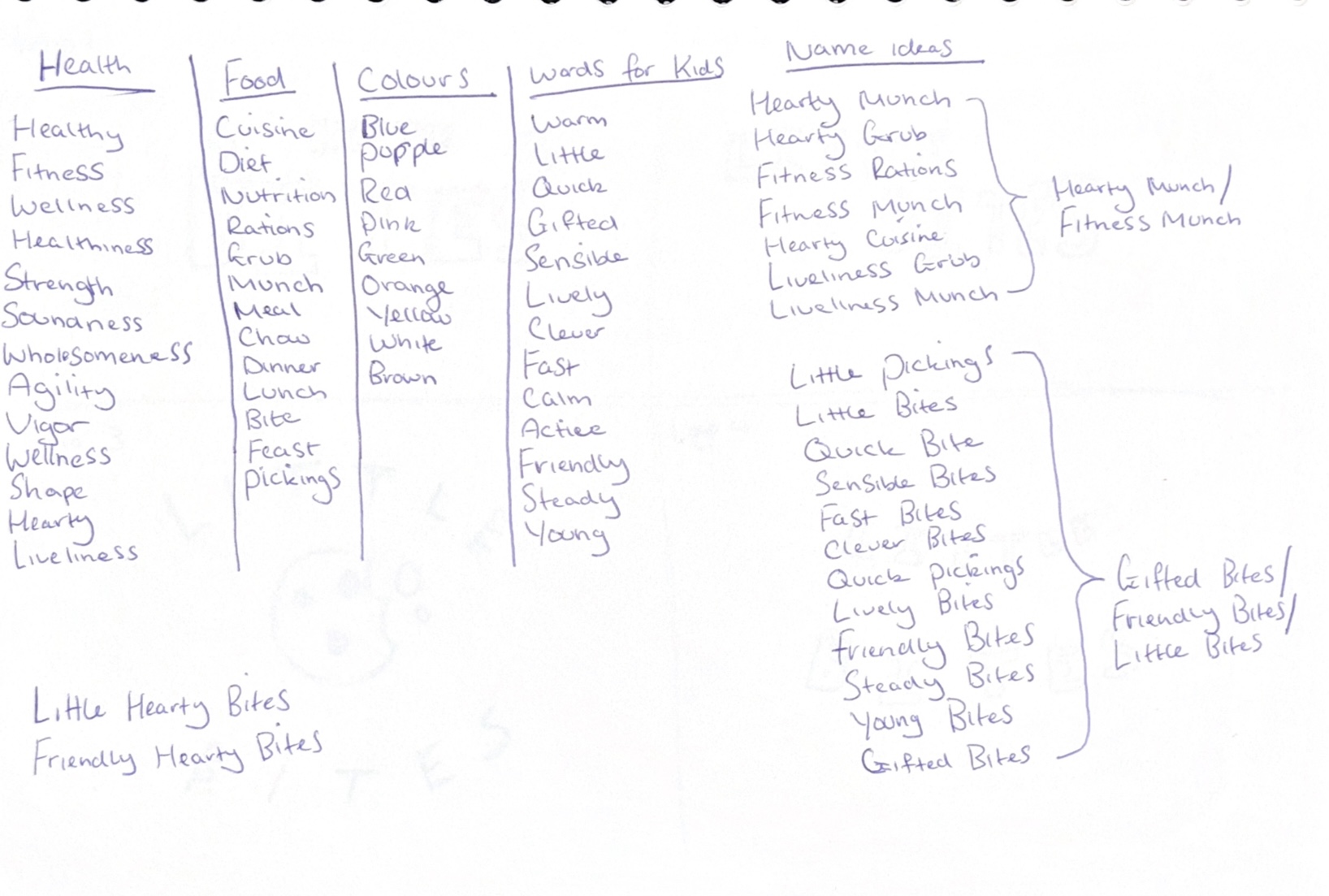
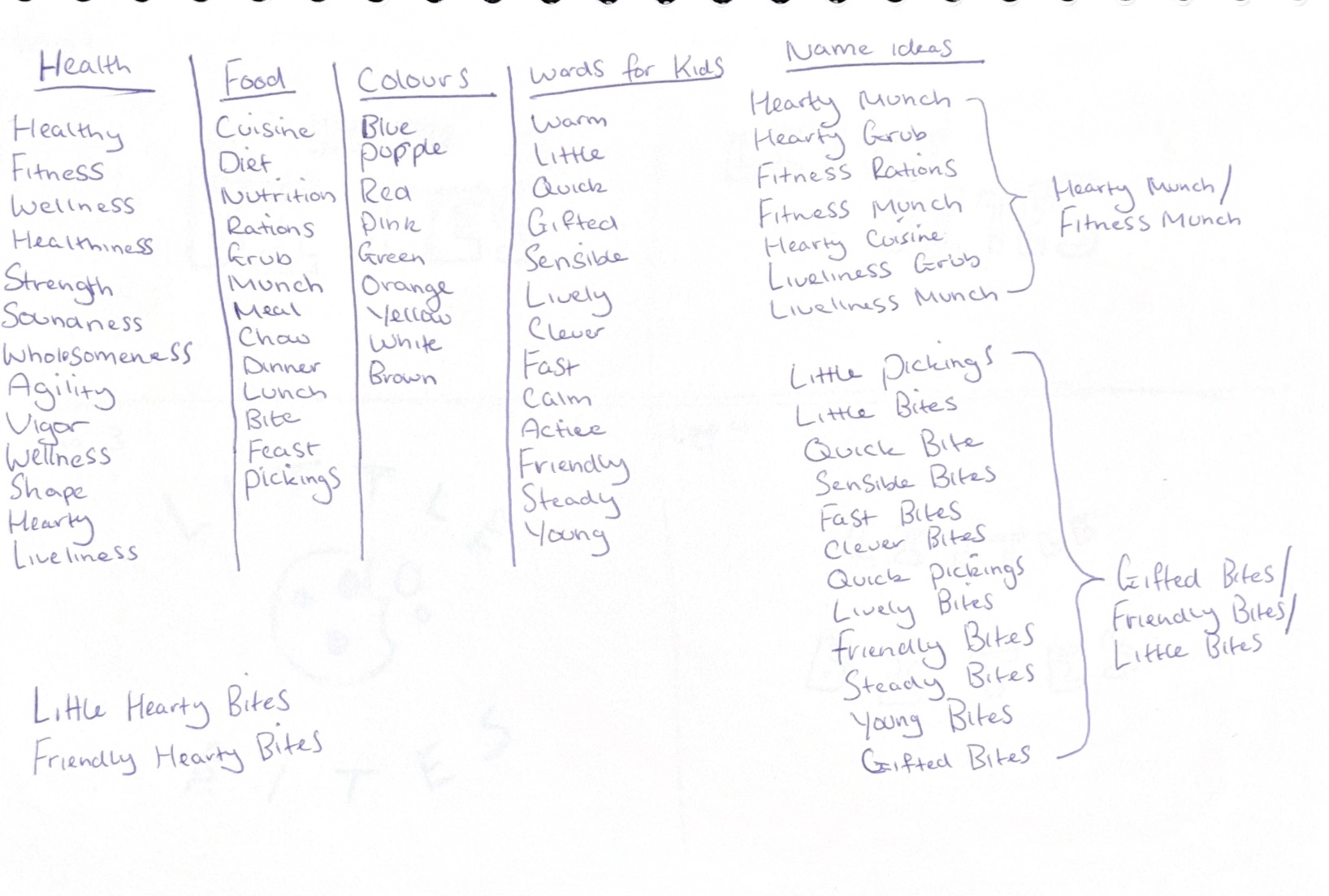
I needed to first create a name for my brand before I started to design a logo. The method I used to create a brand name was to first think of the main ideas of the brand, such as ‘health’, ‘food’, ‘kids’. Then I wrote more words under each topic and thought of as many relating words as possible to see if there were any words which worked when paired together as a catchy name. Some of the first word combinations included ‘Heart Munch’ and ‘Fitness Munch’, but after I got some feedback from others, I decided to think of other names which were more suitable for my target audience. My first name ideas related to health and fitness, but they felt more like products aimed towards gym goers or an older audience. My established audience was younger children and parents who are looking for healthier versions of their kids’ favourite meals.

After I had looked at some other name options, I finally chose the name ‘Little Bites’ which was more suitable for a children’s food brand and conveyed the idea better because the word ‘little’ is more associated with children who are usually quite small, and their portion sizes are also smaller than an adults’. The name is also more catchy and friendlier than other names like ‘Fitness Munch’, which is a lot more generic.

“Some letters and sounds evoke specific emotions. Hard consonants like “K” and “B” create a punchy, bold feel—think Kodak, Buzzfeed, or Kleenex. Meanwhile, softer, vowel-heavy names like “Oreo” and “Spotify” feel friendly and approachable. The choice of sound can subtly signal to consumers what they can expect from your brand.” (Brand Poets, 2024)

The mixture of harder sounds and softer sounds create the impression that the brand is friendly yet also punchy and easy to remember. Sound symbolism is important, and linguist research has shown that some sounds have emotional connections which makes them connect with the customer more (Brand Poets, 2024)

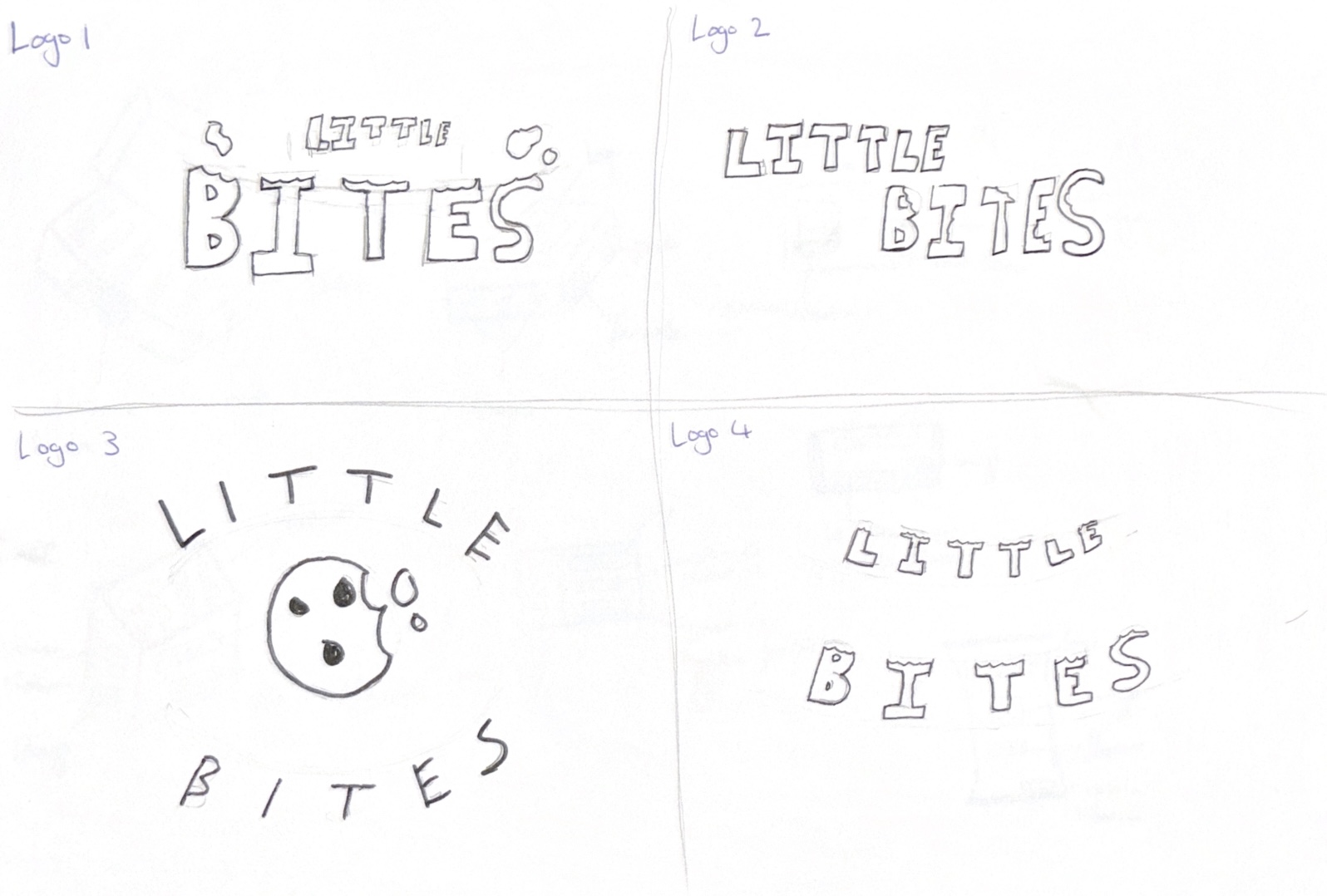
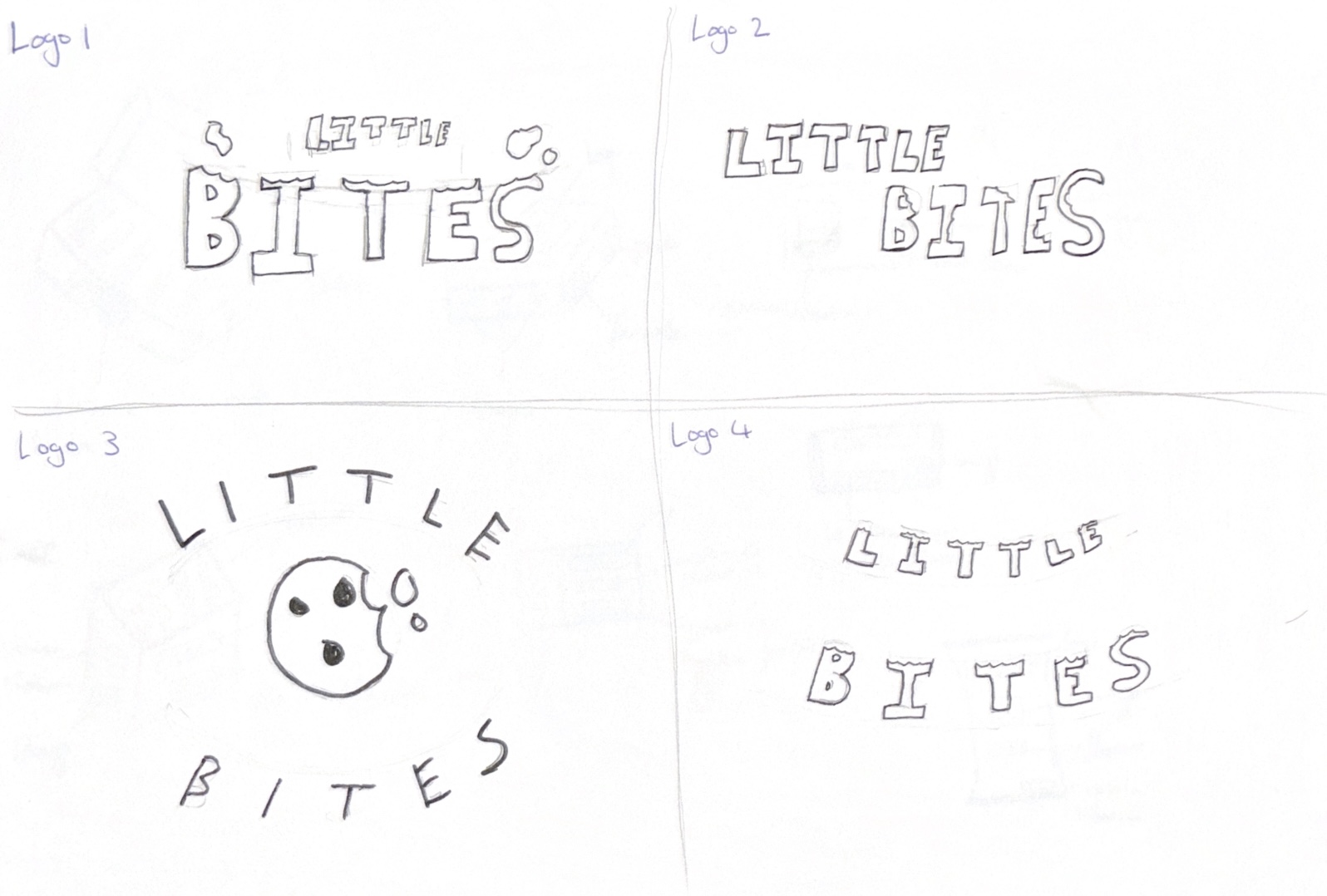
Four Logos I made.

When my name was decided, I started to design the logo. I made four thumbnail sketches to try out different layouts and compositions which I then showed to my classmates early on during my early proposal phase. I tried different styles like making ‘little’ smaller and stacking the words on top of each other. I also tried adding illustration elements such as crumbs around the text and a cookie shape which the text was wrapped around. When I showed these to my classmates, most of them preferred the first and third design, which led me to go and create digital versions to then get more feedback on the two.

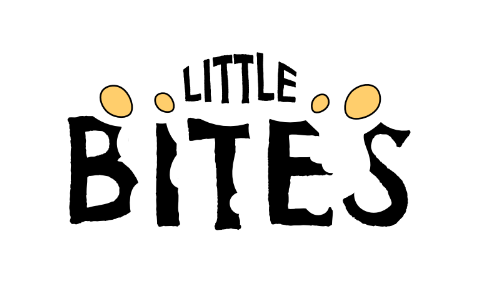
Logo #1 digital version
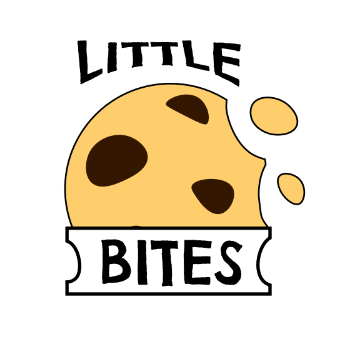
Logo #2 digital version with some changes

In Adobe Illustrator, I made digital versions of the designs that my classmates liked. I found a font called ‘Chelsea Market Pro’ which was similar to the type I had sketched in my thumbnails. The typeface felt suitable because it was easy to read but also had some imperfect elements which made it appear childlike and playful. For the first design, I used the eraser to remove chunks of the type to seem like it had crumbled away, and I added in some circular crumb shapes to show that the logo was associated with food. For the second logo, I went a bit different from my sketch because I thought the layout was a bit boring, so I instead arched the word ‘little’ over the cookie shape to add some movement and then contrasted that by adding a label across the bottom with the word ‘bites’ in. 


I then presented these two to my supervisor who advised me to reconsider the elements in my logo which could be misleading, such as the banner looking like a ticket. He told me to try thinking of how I can show the ‘healthy’ side of the brand and to also consider use of colour. He liked the idea of crumbs breaking off, so I decided to keep that in for my next designs.

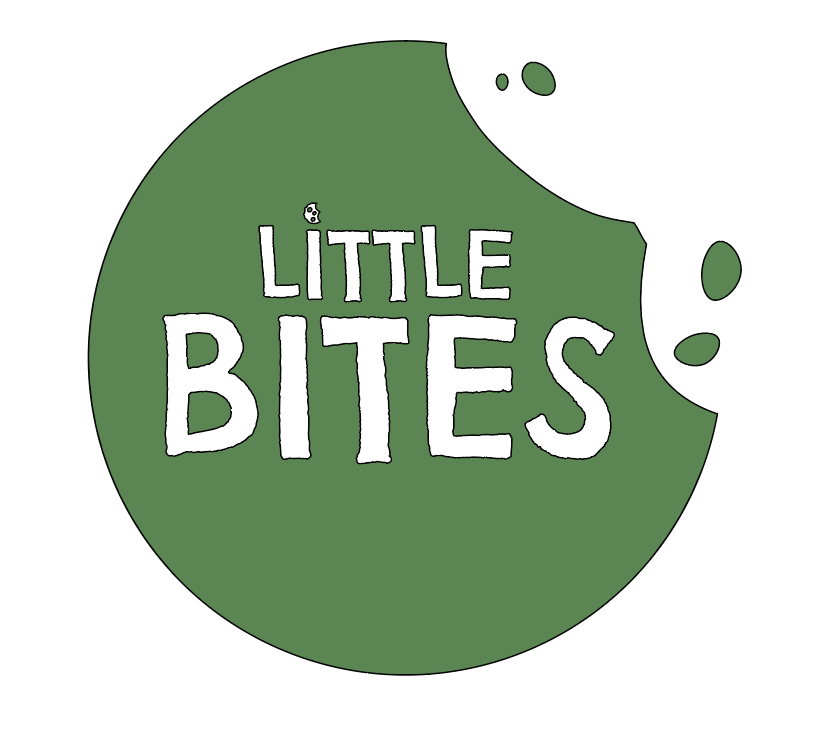
New Logo I made.
New Logo with an reversed version.
Logo with Black Background

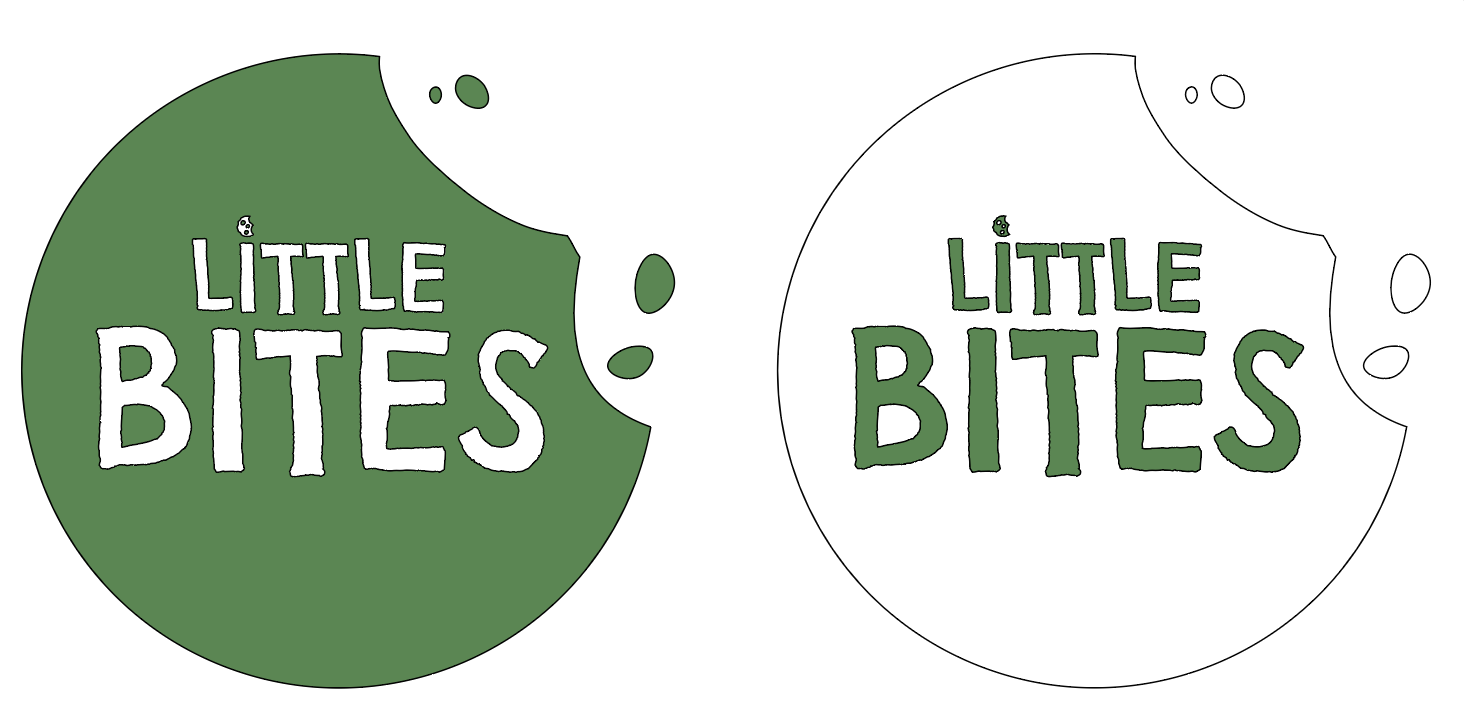
I Went back and reconsidered the logo once more and I decided to contain the text inside of the cookie to create a shape which can be scaled up or down easier to fit in on different formats. I also thought about how I can show the brand is a healthier option, which made me consider the use of colour. 


““Color can play a major role in consumer decision-making. Without even knowing what your product is about, customers initially rely on brand colors to decide whether or not they want to engage and learn more about your brand.” (Canva. Nd) 


I chose to use the colour green in my logo because green links to nature, health and wellness. It is commonly associated with healthy foods such as vegetables and helps to combine the food part of my brand (the cookie icon) with the health part. I kept the crumbs falling from the side of the cookie, but because the shape is more uniform, the logo now has more balance and is more adaptive.


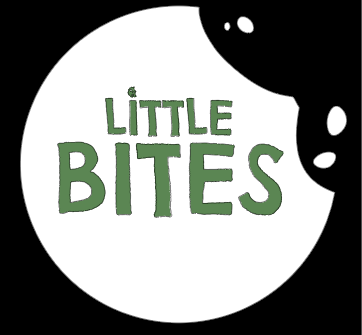
I made some variations to my logo, such as an inverted logo for the chance that I may need to use it on a darker background and need it to stand out. I also created a version where it is just the text without the cookie border, which can be used in different situations where the full logo may not be necessary.


“In today’s dynamic market, adapting and evolving your visual identity is crucial. Logo variations are not just about aesthetics; they’re about creating a versatile brand identity that resonates across all platforms.” (Sandu, 2019)

Reference List:


BrandPoets (2024) What’s in a name? How brand names impact success [Article]. Available online: https://brandpoets.com/2024/10/01/whats-in-a-name-how-brand-names-impact-success/#:~:text=The%20Power%20of%20Sound%20and,is%20balancing%20simplicity%20with%20distinctiveness. [Accessed: 05/02/2025]


Canva (ND) How to choose your brand colours [Article]. Available online: How to choose your brand colors [Accessed: 23/02/25]


Sandu, Bogan (2019) Why logo variations are important and you should have them [Quote]. Available online: https://www.designyourway.net/blog/logo-variations/#:~:text=That%E2%80%99s%20the%20power%20of%20logo%20variations.%20In%20today%E2%80%99s,versatile%20brand%20identity%20that%20resonates%20across%20all%20platforms. [Accessed: 23/02/2025]

Production piece and portfolio

Production piece and porfolio

Production Video

Production Blog

My project is a 3D billboard that advertises The Deep aquarium in Hull. The purpose of the billboard is to promote The Deep to new customers and visitors to the city and push Hull towards a more modern style like other major cities such as Manchester or London, where you may be likely to find a 3D billboard. 

I have chosen to make a 3D billboard as they are a new form of technology appearing in cities all around the world, such as New York, London and Japan. They use impressive design techniques to stand out from the crowd and have had a proven impact on sales for companies such as Nike, which studies revealed had a boost in sales because of a creative 3D advert celebrating 35 years of the Air Max trainer (Fatima, 2023). Some other benefits include enhanced engagement, memorability and increased brand awareness (ClearChannel, nd). 

My plan at first was for The Deep to appear zoomed in to take up the full screen, before zooming outwards to reveal that it is inside of a fish tank, and it is just a miniature figure. Fish swim around The Deep as text begins to rise, telling viewers to get their tickets, along with a QR code which leads to the official website.  

My first Story Board I created.

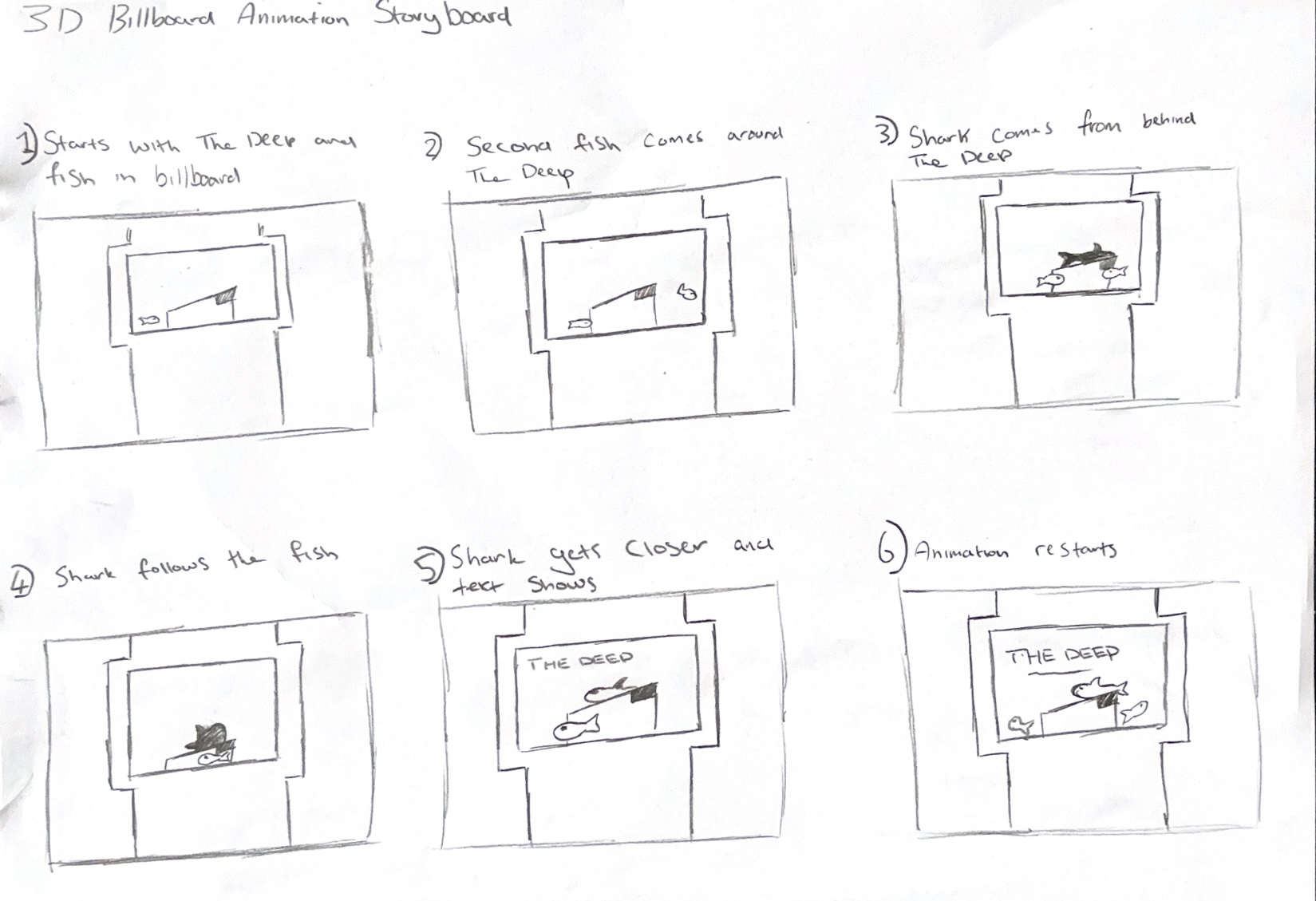
Later, I changed my storyboard because I had some trouble figuring out how to create the zoom out effect. I had to animate all of my objects within the billboard itself, so I couldn’t use the camera to zoom in and out. To save myself time trying to come up with a way around, I made some adjustments to the start of the animation and replaced the zoom-out part with a shark circling The Deep and chasing the fish around the tank. 

My updated Story Board.

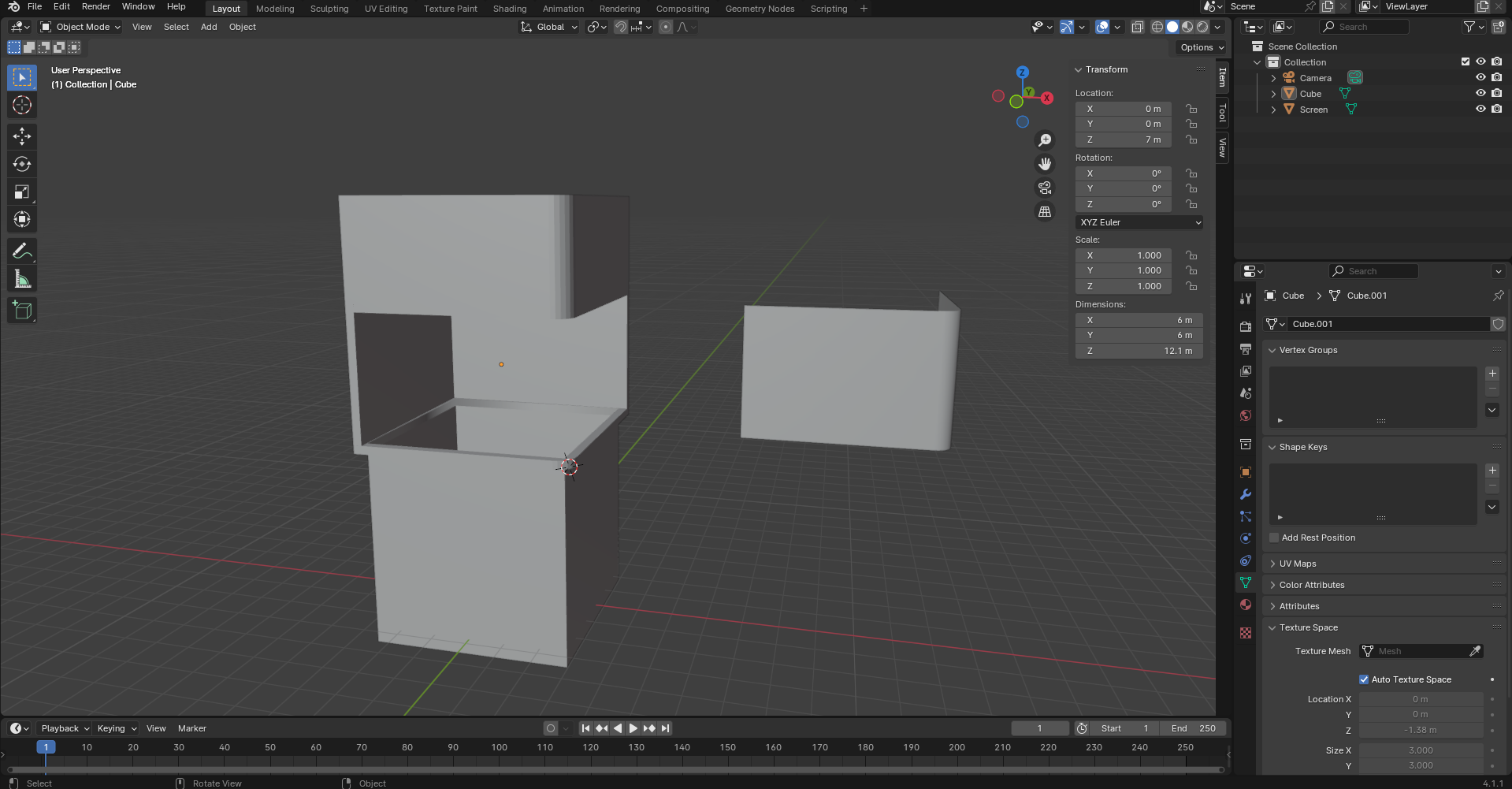
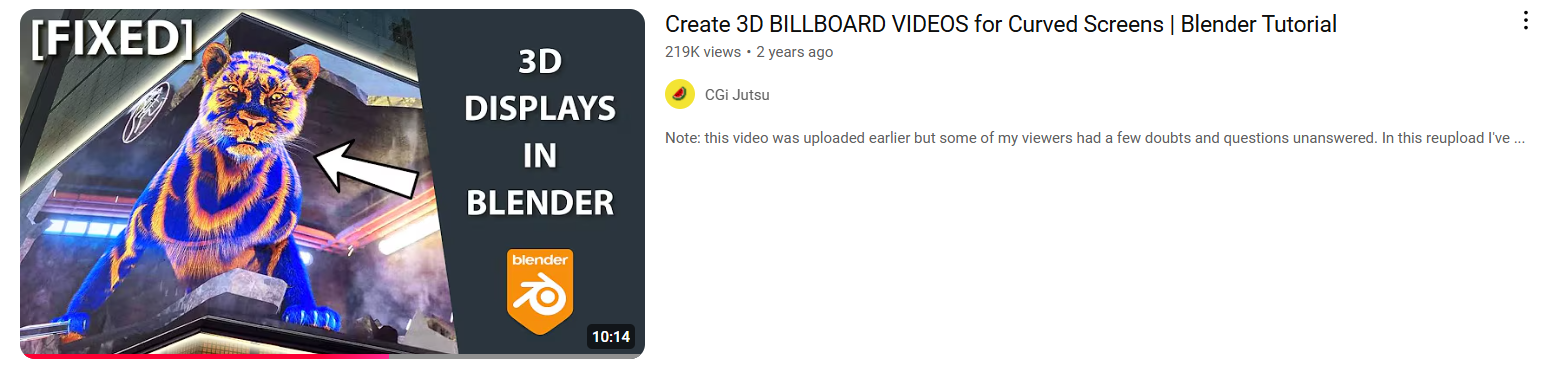
I started off by making the billboard. I modelled it in Blender and followed along to a YouTube tutorial to learn how to create the curved screen to show the animation from two angles at once, making the 3D effect by using a forced perspective and layering. Regular 2D billboards show just one straight-on angle which is less immersive and can be limiting for storytelling. 

Making the 3D Billboard in Blender
3D billboard tutorial

3D billboards use techniques such as stereoscopy to show two different images to each eye to create a warped perspective. To get a similar effect, I used layering and perspective distortion to create the 3D illusion within Blender. I also keyframed the scale of different objects to become larger as they get closer to the foreground, which creates more depth within the frame.

“These billboards use advanced holographic technology to project high resolution, three-dimensional images into space, creating an illusion of depth and realism without the need for special glasses.” (Nova, 2024)

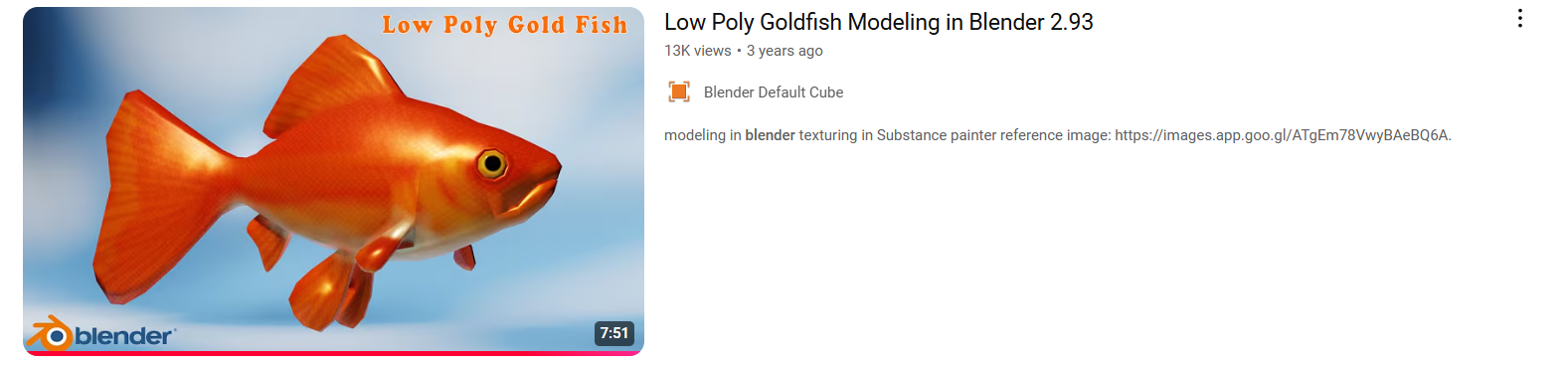
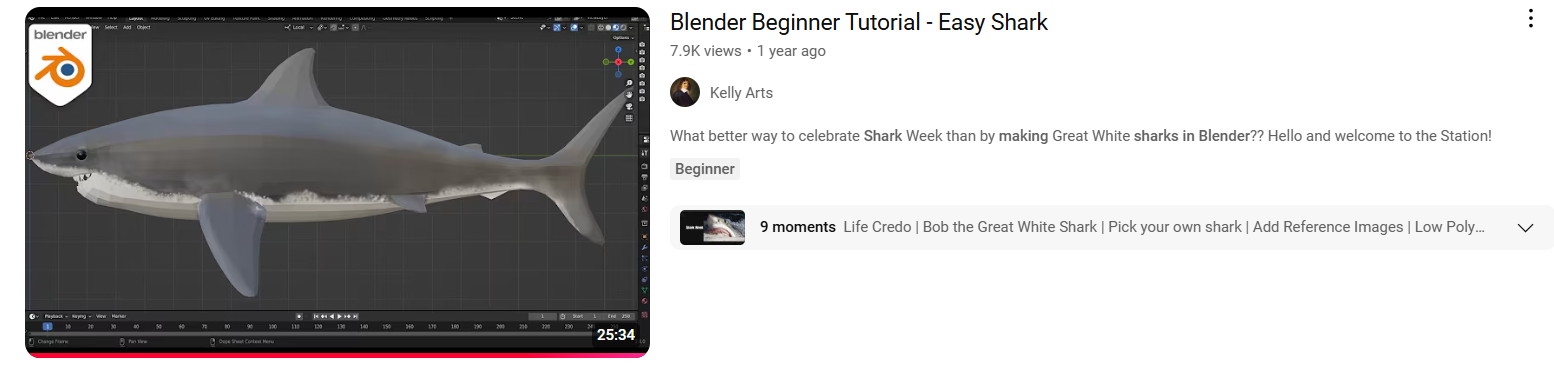
After I had modelled the frame for the billboard, I then started to work on creating other models such as the fish. I followed some more tutorials and used basic modelling and rigging techniques to make the models and added modifiers such as the mirror modifier to model the items faster as I only had to do one half before mirroring what I had already done. I used EEVEE because it renders faster, and I kept details quite low to also make it render faster as having too much geometry or modifiers applied could make it take longer.

Fish tutorial
Shark tutorial

After I made the shark, I began to test if the billboard was effective or not. Originally, I was going to just make an animation in Blender, but one of my teachers suggested using Adobe Aero to place the billboard in real life locations using geo-location tracking. I wanted to see if this was possible, so I did a test file and animated the shark to spin around within the billboard and exported it all as an FBX file. Then I imported the file into Adobe Aero and set the start trigger to play the animated shark on an infinite loop. I placed the billboard outside on campus and asked a classmate to go outside and test if it worked or not, and to take a recording of the billboard. The animation did work but there was one issue which stood out, and it was that the back wall of the billboard was invisible when imported to Adobe Aero, meaning that you could see the sky through the billboard.

After going back and having a look at the Blender file, I learnt that I had to flip the normals for the back faces of the billboard. After I flipped the normals to face correctly I re-exported the model and checked that it was working properly which it was.


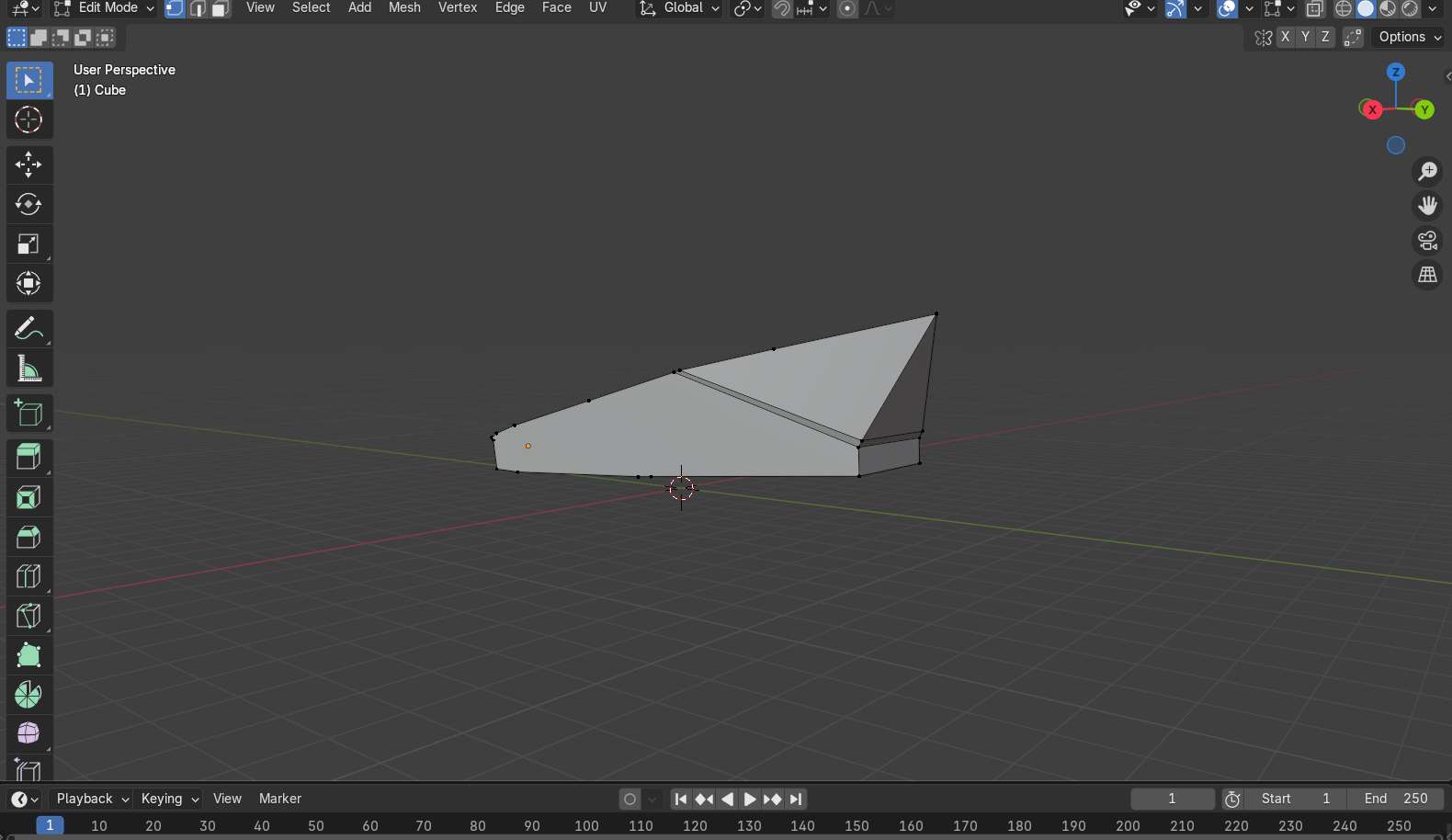
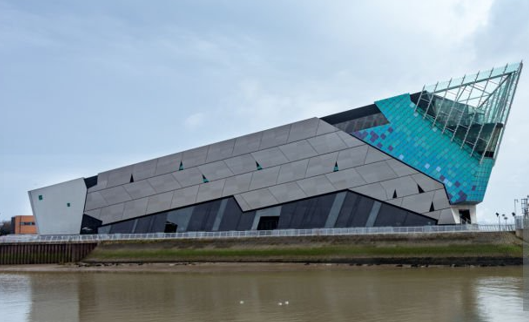
The final thing I had to model was The Deep building. This was the most difficult because The Deep is an unusual shape for a building because it is very triangular and has lots of detailing on the windows. There were also no tutorials, so I had to use various images of The Deep at different angles to use as a modelling reference. Because the model was supposed to be a miniature fish tank decoration figure, I didn’t need to add as many details since it wasn’t meant to be fully realistic.


Making The Deep model
The Deep reference Image

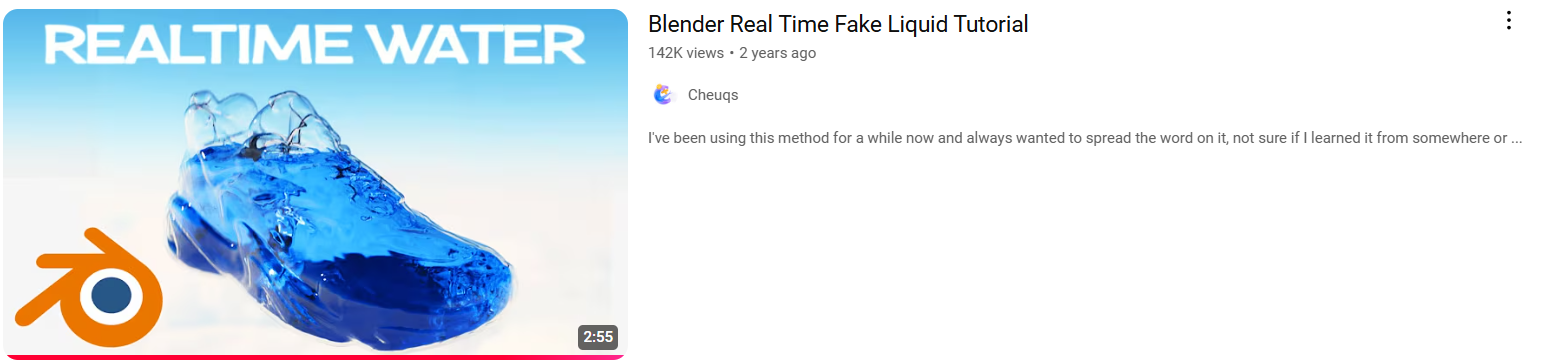
To create the water inside of the tank, I followed another tutorial which shows how to create moving water that is controlled by a plane. I then imported the other models and began keyframing the animations in the scene to create the full sequence. 

Tutorial for water effect

I then tried to bring the new billboard animation into Adobe Aero again but was having issues with some items not exporting correctly due to modifiers and extra geometry, meaning animations wouldn’t play properly. Some of the objects were imported at a smaller size compared to the Blender animation, which made them look like they weren’t there. Another problem was that some of the objects were appearing in the wrong place, such as outside of the billboard and very low down.

Because of the tight deadline, I decided to create an alternative option of simply creating a rendered video displaying how the billboard would look in a public space. I had considered creating a 360 video but switching to Cycles meant it would take too long to render, and there is no Eevee alternative option to speed up render times. In the meantime, I continued to attempt at fixing the issues with the Aero file, such as trying to export the animation as a GLTF instead of an FBX, fixing geometry in Blender, reanimating the scene and adjusting modifiers and effects in the scene to see if any of these were the cause of the problems.

When the animation was rendered, I used Premiere Pro to create an image sequence from the rendered PNGs. I added a city ambience audio clip to add more immersion and detail to the video and make it feel more realistic because I had used a city HDRI for the background, so the sound matched the environment the billboard was in. I chose to use a city HDRI because the style of the scene complimented the design of the 3D billboard as it was more modern, and you would be more likely to find a billboard like this in popularized areas such as busy cities, where there are more pedestrians to see the billboard each day.


Alternatively, I had successfully managed to re-export the billboard into Adobe Aero as a GLTF. I figured that there were some issues with my geometry and applying all transformations helped to fix the scale and position of my objects, so they appeared the correct size when in Adobe Aero. I made the water still because it wouldn’t play when brought into Adobe Aero and wouldn’t fill the tank evenly. All of this seemed to work, and the file was now working correctly when I previewed it in Adobe Aero. 


For the final step, I tested the Adobe Aero file once more. I made two versions, one which used surface tracking and another that used geo-location tracking. The surface tracking version was so I could test and adjust the size of the billboard and make sure there were no issues. It is easier to test this way as I do not need to keep going to the same location to check and I can instead just place it anywhere outdoors. I tested it outdoors because I wanted the billboard to be very large in scale. When I did my research, I noticed that most 3D billboards are around 20 meters high, so to get the correct sizing I had to go outside to check the billboard was the correct size.


For the geo-location-based version, I chose a public place which is quite busy. I did consider somewhere such as Hull city center, but I instead chose to set the location on campus since it was easier for me to quickly adjust the location on one of the University computers nearby if I needed to. The University campus is still effective as it is heavily populated with hundreds of students passing through nearly every day. It would also be a strategic place for an advert for The Deep as there will be a lot of students who are new to Hull and may not be aware of The Deep, leading to more visitors. I had also forgotten to include text in my original animation, so I downloaded a PNG of The Deep logo online and imported it into Adobe Aero. To make the logo fade near the end, I hid the PNG and added a ‘wait’ trigger for 7 seconds before making the logo fade in with the ‘show’ trigger. This lets the viewer know that the advert is for The Deep, leading them to The Deep website where they will hopefully book a visit.

The Deep logo

It took me a few attempts to select the right space for the billboard on campus. At first, the tracking location was slightly off from where I had pinned it, so when I went to view it, it was blocking the footpath. I wanted the billboard to be visible but not obstruct the pavement as that would be an issue for people with mobility issues. I chose a large patch of grass just beside the path leading from the campus accommodation towards the library, which is an area many students pass each day but is out of the way from the accommodations and major buildings on campus. I was thinking of placing the billboard closer to the accommodation, but I thought it may not be suitable to have a large billboard in areas of residency because it could be distracting or off-putting for people nearby.


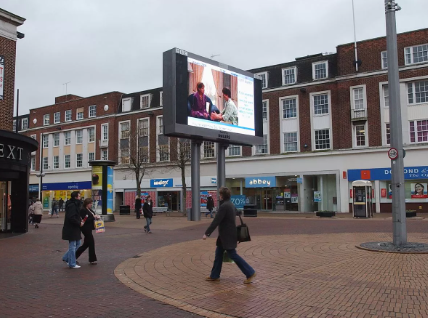
Having 3D billboards brought into Hull could be beneficial as they would push Hull towards technological advancements and make the city feel more modern or progressive. You could also merge the traditional side of Hull with a modernized edge by using 3D billboards to create narratives about Hull’s history. A 3D billboard could be like the BBC Big Screen which used to be in the city center and displayed work created by local artists and designers, only more modernized and trendier with the updated technologies of 3D billboards.

BBC big screen in Hull

Portfolio

Blender video:

Adobe Aero video:

References

Blender Default Cube (2021) Low Poly Goldfish Modelling in Blender 2.93 [Video]. Available online: https://www.youtube.com/watch?v=S5khzrdH_eM [Accessed: 21/11/2024]


CGI Jujitsu (2022) Create 3D BILLBOARD VIDEOS for Curved Screens | Blender Tutorial [Video]. Available online: https://www.youtube.com/watch?v=xK3q641dd2c&t=367s [Accessed: 15/11/2024]


Cheuqs (2022) Blender Real Time Fake Liquid Tutorial [Video]. Available online: https://www.youtube.com/watch?v=F6KsMr7exCc [Accessed: 5/12/2024]


ClearChannel (nd) Guide to 3D advertising and examples of innovative 3D billboards [Article]. Available online: https://www.clearchannel.co.uk/new-to-out-of-home/make-the-most-of-your-ooh-marketing-campaign/guide-to-3d-advertising-and-examples-of-innovative-3d-billboards [Accessed: 22/12/2024]


Fatima, Maheen (2023) Everything You Need to Know About Nike Air Max 3D Billboard in Japan that surprises the world [Article]. Available online: https://brandingforum.org/general/everything-you-need-to-know-about-nike-air-max-3d-billboard-in-japan-that-surprises-the-world/#:~:text=This%20billboard%20advertising%20kicks%20in,people%20worldwide%20into%20potential%20customers. [Accessed: 01/11/2024]


KellyArts (2023) Blender Beginner Tutorial – Easy Shark [Video]. Available online: https://www.youtube.com/watch?v=LrHqjSEwjHk [Accessed: 18/11/2024]


KM007_ (2021) City Ambience [Audio]. Available online: https://pixabay.com/sound-effects/city-ambience-9272/ [Accessed: 23/12/2024]


Mischok, Andreas (2020) Canary Wharf HDRI [HDRI]. Available online: https://polyhaven.com/a/canary_wharf [Accessed: 23/12/2024]


Nova, Vallerie (2024) Understanding How 3D Billboards Work: The Magic of Naked Eye [Quote]. Available online: https://www.ubunzo.com/blog-posts/understanding-how-3d-billboards-work-the-magic-of-naked-eye [Accessed: 22/12/2024]


The Deep (2024) The Deep Logo [Image]. Available online: https://www.thedeep.co.uk/sites/default/files/logos/thedeep.png [Accessed: 23/12/2024]


Unknown (nd) BBC Big Screen in Hull [Image]. Available online: https://i2-prod.hulldailymail.co.uk/news/history/article1606753.ece/ALTERNATES/s1200b/0_big-screenJPG.jpg [Accessed: 22/12/2024]


Unknown (nd) The Deep [Image]. Available online: https://media.istockphoto.com/id/939236112/photo/the-deep-an-aquarium-in-hull-england-exterior-view.jpg?s=612×612&w=0&k=20&c=qDl43YZU9uMpBB4Eaa8NUh2RMC3JXqAI0oqzCqMuJ6c= [Accessed: 14/12/2024]

Research Proposal

Research Proposal

My idea for my Emerging Technology project is to create a 3D billboard AR experience with the purpose of promoting the heritage and culture of the city of Hull. The aim of my project is to promote key points of interest in the city such as The Deep, Museum Quater and other intriguing areas within the city. Through this project, I hope to attract more tourists and general interest in Hull and its history and culture. 


3D billboards are a good way for companies to market their products as it gives the viewer a better look at the product. They are more eye catching than 2D billboards because 3D billboards make it look like the product is popping out of the billboard, making more people look at what is happening, and allowing them to see the full product design.  


3D billboards are a unique and innovative way for companies to market their products as they are eye-catching and engaging. Unlike regular 2D billboards, 3D billboards create a sense of depth and immersion through layering, perspective, animation and lighting to make it seem as if the elements are jumping out at the viewer. 3D billboards catch a lot of attention and often get shared on social media as a result. For example, a 3D billboard in Tokyo gained lots of online attention because of the impressive use of technology. The screen is 155 square feet in size and is very hard to miss.

The brain processes this binocular disparity to perceive depth and create a three-dimensional experience. 3D billboards capitalize on this concept to create a convincing sense of depth. The images come to life by combining two separate images taken from different angles. This technique tricks our brains into perceiving objects in the display as if they’re jumping out of the screen. It’s a visual effect commonly known as forced perspective.  (Gavrilova, 2023) 

What makes a 3D billboard effective is how they can bring a story to life with complex animations, unlike a 2D billboard using a static image. Characters and objects appear to be coming out of the billboard and interacting with the world around them, making them stand out much more. These billboards are often found in major cities such as Tokyo, New York and Dubai, which are all known for been ‘modern’ and trendy cities to visit. These billboards enhance the feeling of these technologically advanced cities and draw more interest, which is something I’d like to do for Hull by reviving its image and pushing it towards a trendier and more modern feeling. 

“3D ads stand out from the crowd, making them easier for viewers to remember. This has a positive effect on brand awareness, with one study showing that 3D billboards achieve greater attention, ad recall and ad recognition than traditional billboards”.  (Clear Channel, nd)

3D billboards are memorable and lots of companies are starting to utilize them to market their products in unique and creative ways. Companies such as Nike, WhatsApp and Activision are just some of the big names to have used 3D billboards to advertise their products. One example is from 2022, when Activision created an advertisement on a 3D billboard in London to promote their new Call of Duty game. The advert showed a character smashing through the glass before reaching out to rip the wires from the billboard before cutting to black to reveal a soldier who comes out of the screen before the Call of Duty logo appears. This is an effective example because it tells a story and uses clever perspectives and visuals as well as sound effects to immerse the viewer. 

Nike also used a 3D billboard to celebrate their 35th anniversary of their Air Max trainer in Japan. They used this to show off different types of trainers throughout the years, with interesting transitions and graphics. Doing this gave Nike a boost in sales showing that the 3D billboard was effective and convinced viewers to purchase from Nike (Fatima, 2023) 

3D billboards use anamorphism to create an optical illusion which makes the billboards appear to be 3D when they are technically not. This is why most 3D billboards are placed very high up compared to the viewer, as the angles make the viewer perceive it as three dimensional due to perspective tricks. 

Anamorphic (3D) billboards employ an optical illusion technique called anamorphosis, crafting distorted images that seamlessly align into clarity from specific viewpoints, captivating audiences with their visually striking effects. Leveraging high-traffic areas like city streets and public squares, these billboards offer advertisers a unique and attention-grabbing platform to create memorable campaigns. ” (Priority, 2024)  

My target audience for this project will be tourists who are visiting Hull for the first time and would maybe like to know the best places to visit in the city, businesses and business owners who are looking to advertise their companies in interesting ways, and the council who would maybe want to promote the city and add a modernized feeling and appeal for visitors and people who live in the city. I have considered each of my target audiences’ needs and wants from a 3D billboard, and came up with solutions on how I will provide these for them. 

User: Tourist visiting Hull for the first time 

User Needs: ‘It is my first ever time visiting Hull. I would like to see what the best attractions and activities around the city are so I can make fun memories and make the most out of my visit.’ 

Solution: The billboards will be informative on interesting places around the city, using graphics and storytelling to attract tourists and visitors to these places. 

User: Business Owners 

User Needs: ‘I am the owner of a museum based in Hull. I am looking for new and fresh ways that I can promote the latest exhibit.’ 

Solution: The billboards offer a trendy and innovative way for businesses to promote their companies. They also allow businesses to get creative with the storytelling of their advertisements and can attract a wider audience.’ 

User: The Council 

User Needs: ‘I am the head of Hull City Council, and we are searching for ways to push the city towards a more modern feeling to compete with cities like Leeds and York. We want something exciting for both residents and tourists.’ 

Solution: 3D billboards are a great way to modernize a city and make it feel more advanced. You can also use them to engage and interact with the public, making them memorable and exciting for both residents and visitors. 

To create my 3D billboard, I will use Blender to create the animations and a mixture of my own 3D assets and downloaded ones to create narratives, I will use free sound effects downloaded online to add into the billboards too. I will also create a QR code which can be scanned at the end of the animation to take users to the websites for the attractions so they can find out more information and buy tickets.  


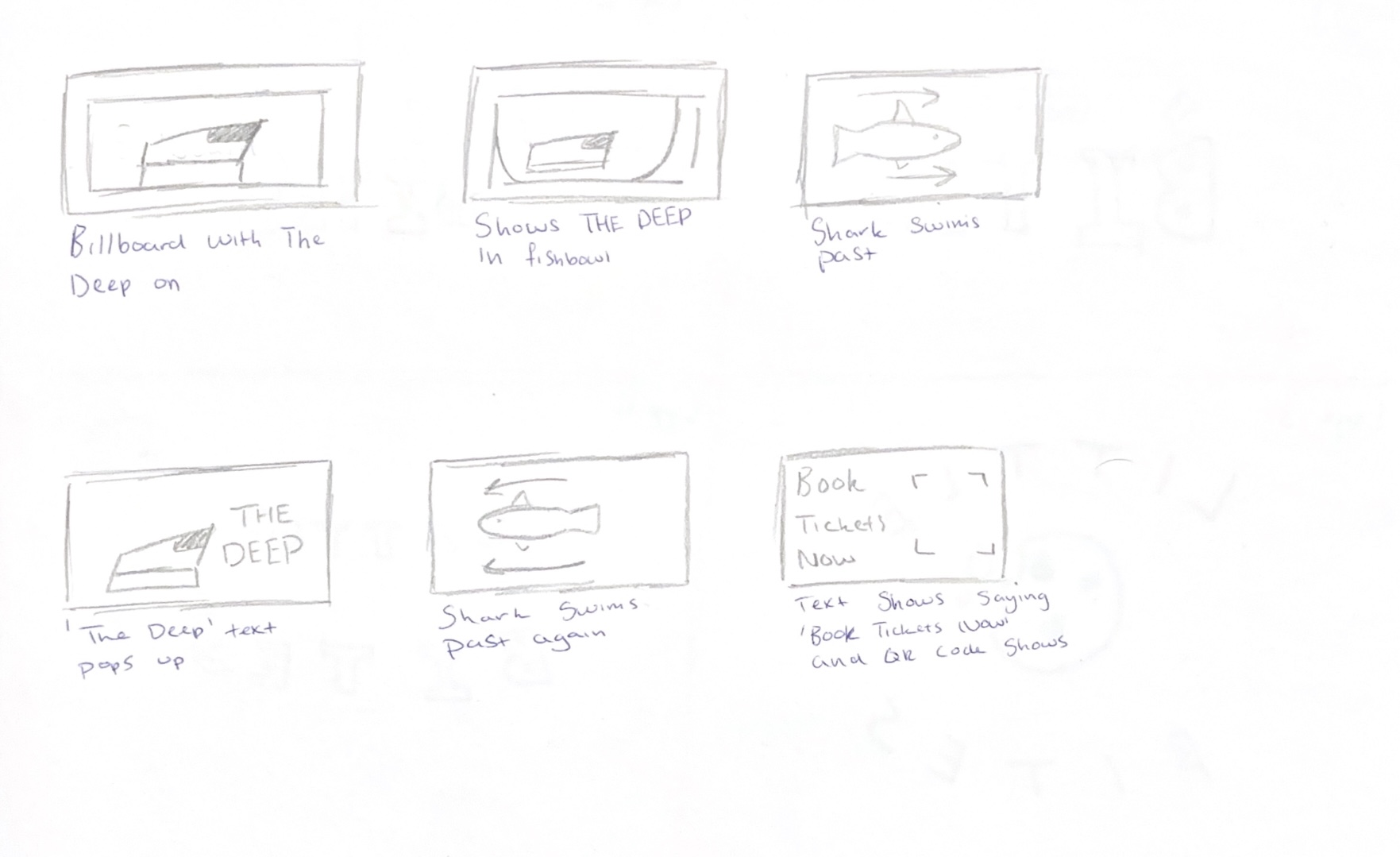
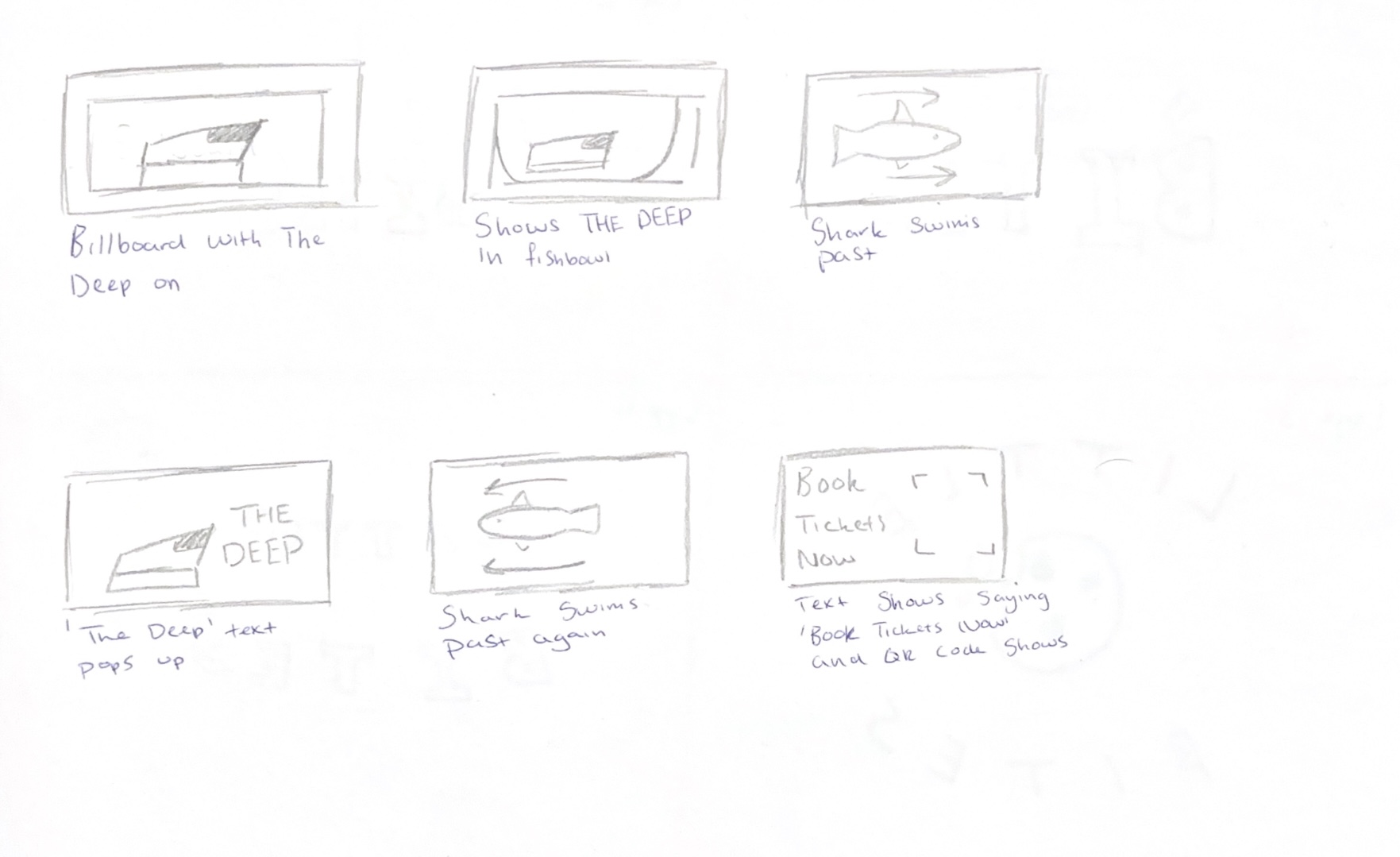
I have made a rough storyboard to plan a 3D billboard animation for The Deep. It begins by showing The Deep building and then zooms out slightly to reveal that it is a miniature model placed inside a fish tank, then a shark passes by, covering The Deep and creating a transition as it passes by. Then there will be The Deep logo that pops up, once this has happened the shark will swim past again creating the same effect as before. Then text with show again, this time saying, “Book tickets now” and a QR code which viewers can scan their phones with to go to their website and find out more information and buy tickets.  

3D billboard story board

“While visuals captivate the eyes, sound design adds a layer of richness that resonates with emotions, enhances storytelling, and elevates the viewer’s engagement.” (Sea Studio, 2024) 

For sound, I am going to add some aquatic music in the background, then the sound will become muffled as if underwater and a swooshing noise will be made when the shark passes by. Sound adds more enhanced senses to the animation and will make the experience more believable and convincing.  


For my 3D billboard, I have to think about ethical considerations and potential issues. 

The biggest issue is the technology itself, as technology can be unreliable at times and this could lead to some issues with the display of the billboard, which runs off LED panels and monitors. Speakers may also become damaged, and this could affect the sound quality. Other factors such as weather and the elements could potentially damage the billboard too, as well as vandalism from the public. Rain could damage the wiring or electrical systems and lead to dangerous situations, and bright sunshine may make it harder to see the screen. It is important to consider how to protect the screens from the elements and to consider the location and design of the billboard in advance. 


The cost to repair this could be very high and may be an issue for local council who may only have a set budget. Additionally, the cost of electricity could be an issue too as these screens would likely need a lot of power to work properly. A fix for this could be to install solar panels which power the billboard, which would also be much more sustainable and eco-friendlier.  

The billboard may also be quite distracting, particularly for road users. Location is important to consider because it could be dangerous to place a 3D billboard in an area with high volumes of traffic, as it could become a public safety hazard.  

But a billboard in an already cluttered and busy road environment with multiple dangers (junctions, pedestrians, cyclists, etc), simply increases the cognitive load your brain must endure, lengthening your reaction times to dangerous situations. New digital billboards are even more distracting as our eyes are attracted to moving images much more readily than static images. Digital billboards are also more visible at night.” (Cottingham, nd)  

Additionally, due to the bright LED screens, visibility for road users could be affected at night, leading drivers to become dazzled and unable to see, which may lead to accidents and injuries. 

Luckily, many of these won’t be an issue for my project as I will be creating a render to display the 3D billboard in-situ rather than it being displayed out in the real world. However, these are still important to consider in case I ever were to create a live 3D billboard. 

Digitally, I will still have to make considerations for things such as render times and project management. If I want a more realistic looking advertisement, I will have to use Cycles to render out the final product, meaning it will take a lot longer than rendering in EEVEE. Because of this, I will have to manage my time wisely and leave enough time to render and add in effects post-production such as sound.  

Digitally, I will still have to make considerations for things such as render times and project management. If I want a more realistic looking advertisement, I will have to use Cycles to render out the final product, meaning it will take a lot longer than rendering in EEVEE. Because of this, I will have to manage my time wisely and leave enough time to render and add in effects post-production such as sound.  

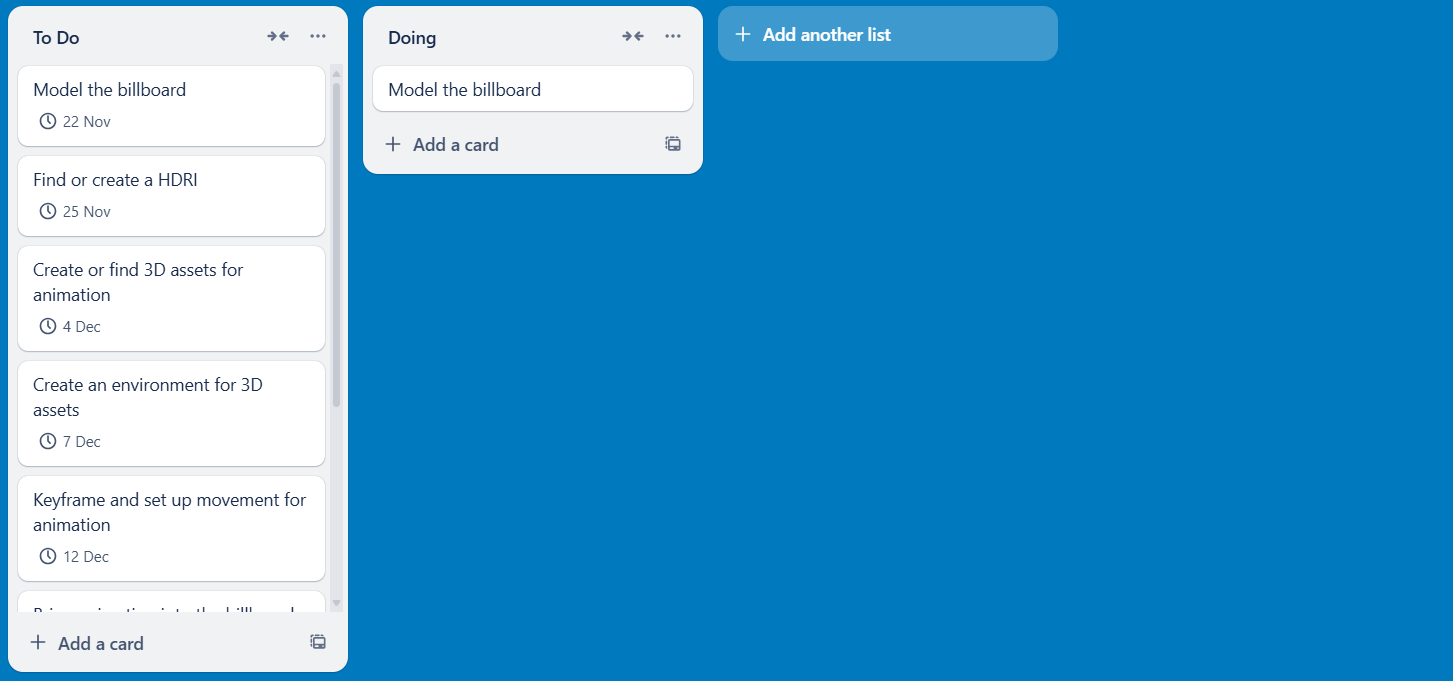
Trello board I made for this project

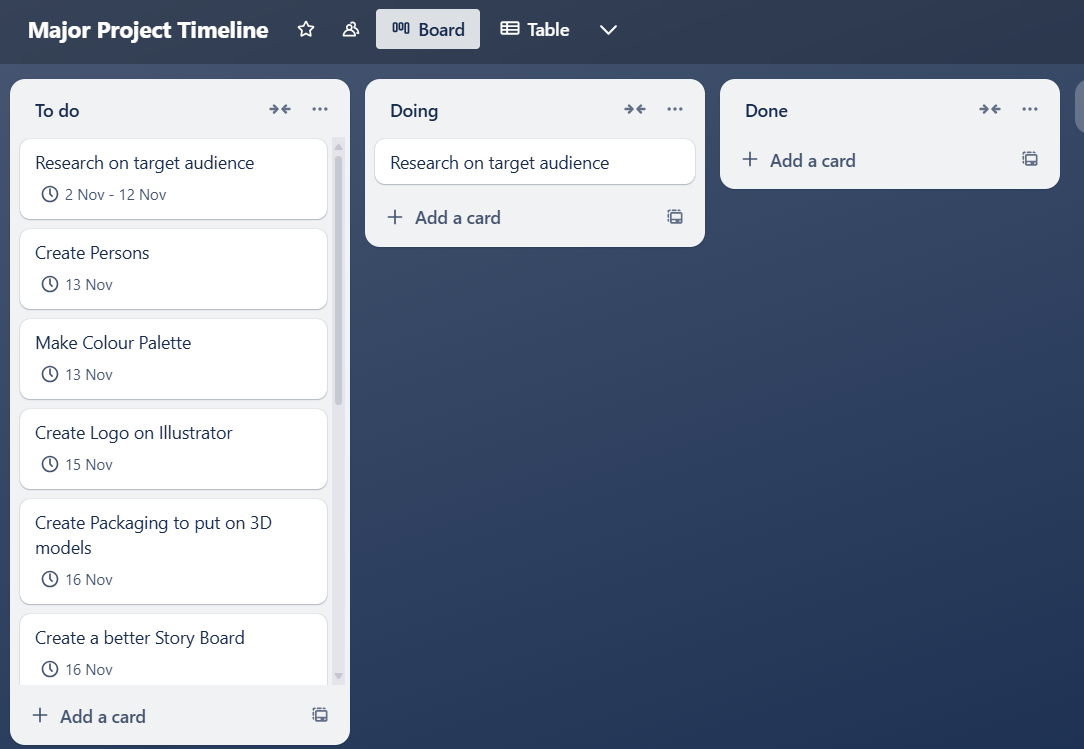
To manage the time scale of this project, I have made a Trello board to set goals and time frames for each part of the project. The sections I have broken the project down into are: 

  1. Model the billboard. I will not be able to place my animation onto an actual billboard, so I will have to make one in Blender which I can display the animation on. These screens are usually curved and use anamorphisms which is a form of distortion used to trick the viewer into thinking something is three dimensional due to forced perspective.
  2. Find or create an HDRI. I will have to create an enviroment to display the billboard in. It will have to look like Hull, so I will likely go outside and capture my own images which I can use as an environment texture. I will use Photoshop to turn my own image into a HDRI which can then be imported into Blender as an enviroment. 
  3. Create or find 3D assets for animation. I will need to create a model of The Deep and a shark and some fish to fill out the aquarium scene. I will most likely have to make my own model for The Deep building but can look for fish and shark models online.  
  4. Create an environment for 3D assets. I will have to make an underwater environment using geometry nodes to place the assets in for my animation. 
  5. Keyframe and set up movement for animation 
  6. Bring animation into the billboard scene 
  7. Render animation 
  8. Add sound, typography and QR code in post-production using After Effects or Premiere Pro  

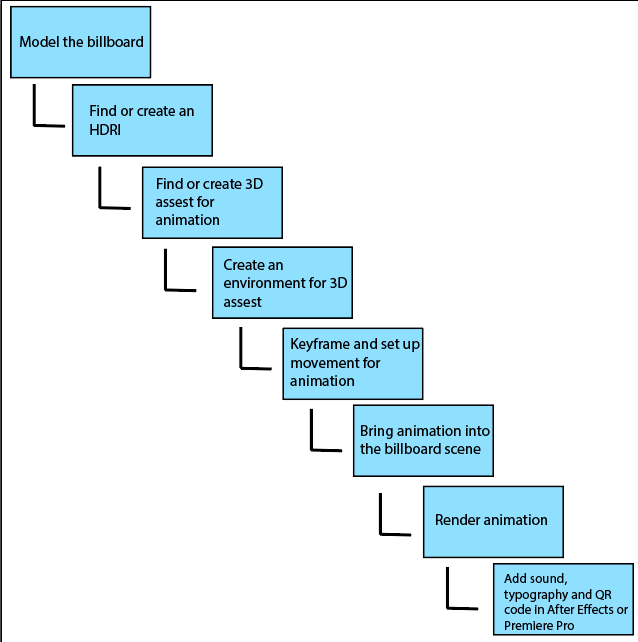
This is a very linear process, and each step leads into the other. I have given myself rough time estimates to complete each step by, but I have added more time than I anticipate for each step for flexibility. I made a waterfall chart based on these steps to show how they lead from one to the other.

Waterfall chart

Each week, I will meet with a group of classmates to discuss progress and get feedback and suggestions for the project through scrum group meetings. This will also help me to keep on task with my work as I will be encouraged to do more work to get feedback every week. 

References

Clear Channel (nd) Guide to 3D advertising and examples of innovative 3D billboards [Article]. Available online: https://www.clearchannel.co.uk/new-to-out-of-home/make-the-most-of-your-ooh-marketing-campaign/guide-to-3d-advertising-and-examples-of-innovative-3d-billboards [Accessed: 01/11/2024]
 

Cottingham, Darren (nd) How distracting is roadside advertising? [Article]. Available online: How Distracting is Roadside Advertising? [Accessed: 02/11/2024]
 

Fatima, Maheen (2023) Everything You Need to Know About Nike Air Max 3D Billboard in Japan that surprises the world [Article]. Available online: https://brandingforum.org/general/everything-you-need-to-know-about-nike-air-max-3d-billboard-in-japan-that-surprises-the-world/#:~:text=This%20billboard%20advertising%20kicks%20in,people%20worldwide%20into%20potential%20customers. [Accessed: 01/11/2024]
 

Gavrilova, Alexandra (2023) How 3D Billboards Work: Everything To Know! [Article]. Available online: Look Blog: How 3D Billboards Work: Everything To Know! [Accessed: 01/11/2024]
 

Priority (2024) Anamorphic Billboard Advertising [Article]. Available online: https://priorityoutdoor.co.uk/anamorphic-3d-digital-billboard-advertising/ [Accessed: 01/11/2024]
 

The Clios (2022) Nike 3-D Air Max Billboard [Video]. Available online: https://www.youtube.com/watch?v=kPeXRJyIjwA [Accessed: 01/11/2024]
 

Sea Studio (2024) The Crucial Role of Sound Design in Animation and Motion Graphics [Article]. Available online: The Crucial Role of Sound Design in Animation and Motion Graphics | by Sea Studio | Medium [Accessed: 02/11/2024]


The Drum (2022) Call of Duty: Modern Warfare II [Video]. Available online: https://www.youtube.com/watch?v=hXisHwtwWUY [Accessed: 01/11/2024]


Tokyo NHK (2022) [4k] Giant 3D Cat on Billboard in Shinjuku – Tokyo Japan 3D 猫新宿東京 [Video]. Available online: https://www.youtube.com/watch?v=_tEu9hWGQWQ [Accessed: 01/11/2024]

Schedule

Schedule

Trello board for my Major Project

This is my Trello board that I have made to keep track on the different parts of my Major Project and to help make sure I am on time with my work. I have broken down the project into smaller tasks for better management and will be starting off with some research on my audience before I start the branding for my product range. This includes the logo, colour palette and visual identity. Once that is completed, I will make packaging mock ups, adverts and then my product animation to show off all the different products. I will then work on the last parts of the project such as the website mock up and social media posts.

Sample Art Work

Sample Art Work

I first started off by doing some idea generation for the name of my brand. I did this by using word associations to come up with ideas based on words relating to my brand idea, such as ‘healthy’ and ‘food’. The reason why I tried creating a name first was so that I could create logo ideas using the words I picked out in my idea generations. The name I eventually decided on was ‘Little Bites’ because it feels more appropriate for young children who tend to be small and their portion sizes are smaller, like ‘little bites’. Some of my other ideas for the name were ‘Hearty Munch’ and ‘Fitness Munch’ but these names didn’t seem to be aimed more towards children. 

name idea generation


I then made four thumbnail sketches for my logo where I tested out different ideas and compositions of the logo. I started by drawing Little Bites in different styles, making ‘little’ smaller, stacking the words and curving the text to add in motion. I also tried out adding bite marks to the words to look as if someone has taken a bite out of the logo, and for another logo I added in a cookie which has been bitten into between the two words. I asked some classmates for feedback and most of them said either choice one or three were their favorites. To help make my final decision, I am going to make digital versions of both these logos and add them to packaging mockups, then show them to my classmates again for more feedback to see if their thoughts change. 

Four logo sketches that I made for my product.


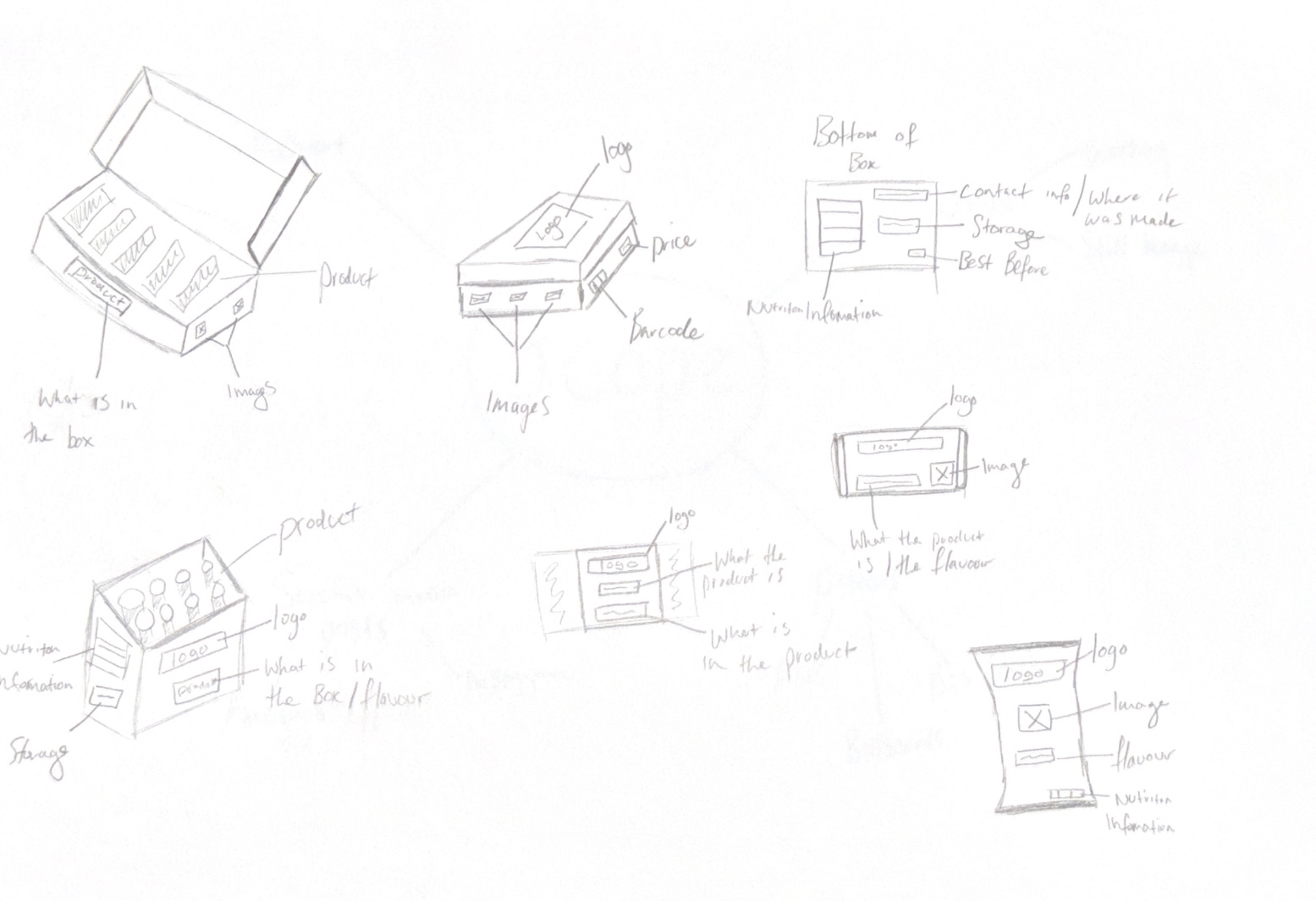
Next, I tested some packaging layouts, planning where the logo, images and information may go and experimenting with different shapes and sizes for the actual packaging. I sketched some crisp packets, chocolate bars and takeout boxes to see how the information would fit on different forms of packaging. This helped me visualize how I may present the designs and display relevant information. I would like to try some experimental designs for the packaging to make my products more eye-catching and innovative, and I would like to promote sustainability through material choices and recycling options. 

Packaging layouts I created for my product.

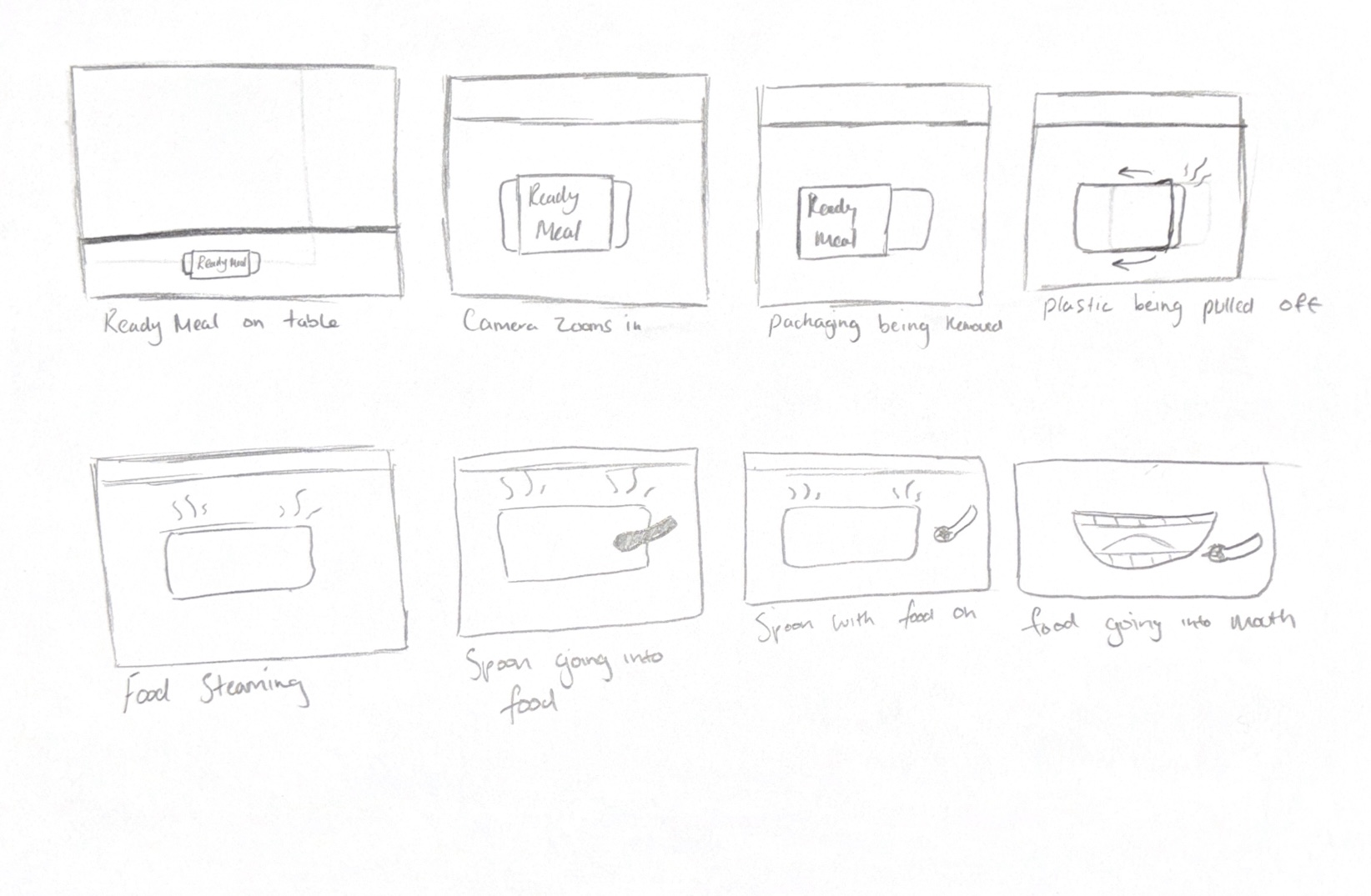
I want to create an animation to promote my product range, and I have created a short storyboard to plan out how the animation may play out. In this storyboard, you can see the product being opened and the items inside are displayed. I will develop this idea to include a better story with a beginning, middle and end, but the main purpose will be to show off the range and advertise it to my target audience. I would also like to make a mascot to promote the brand and bring into the animation as a character in the story, like how other brands use characters to make their products appealing particularly to young children. 

Animation storyboard

VR Immersive Art

VR Immersive Art

In week four of emerging technologies, we tested out the VRs and Adobe Aero. In the lesson, we worked in small groups using different applications to make Immersive artwork in the VR headset. 

Immersive art can be used in many ways. For example, it could be used in museums, theatre, festivals and marketing or branding campaigns to create enhanced experiences which users will remember and talk about, which makes more people interested in going themselves. VR headsets can make this experience even better. One way that VR headsets can be used in immersive art is through art exhibitions at museums, with TATE’s Modigliani exhibition which recreates the artist’s studio in VR for users to walk around and view his paintings. 

The Modigliani VR: The Ochre Atelier reimagines Modigliani’s final Parisian studio, where he lived and worked in the final months of his life in 1919 and 1920. A previously undocumented space, the artist’s studio has been brought back to life through more than 60 objects, artworks and materials. (TATE, 2024)

This experience allows visitors to view the studio of the artist and see their work in a realistic setting. The real studio may not be able to be visited anymore, so this experience offers an alternative way for visitors to see it and gives them a deeper look at the artist and his work. 

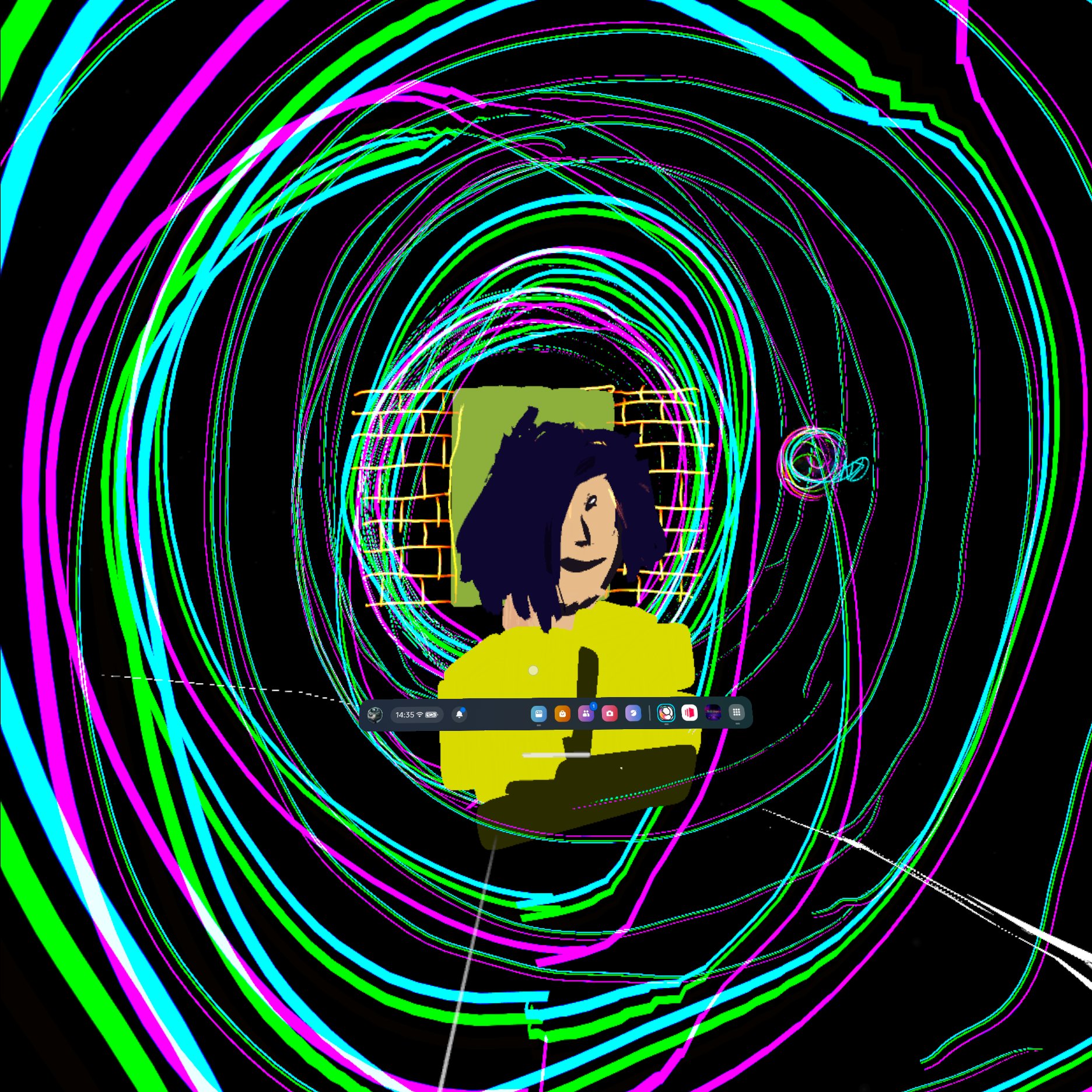
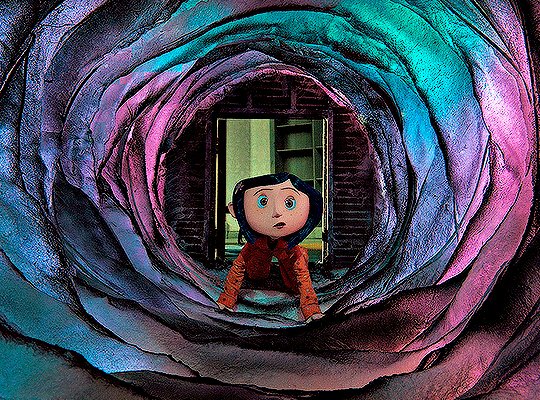
In our groupwork, we used OpenBrush which is an app on the VR which lets you draw in 360. We remade a scene from the Coraline movie where there were lots of circles and a tunnel the main character was looking through. We took this image and made it 3D so the portal filled the 360 space. Everyone took turns and we watched each other by using the iPad to mirror the screen and give feedback to the person drawing.  

Coraline diorama
Inspiration image

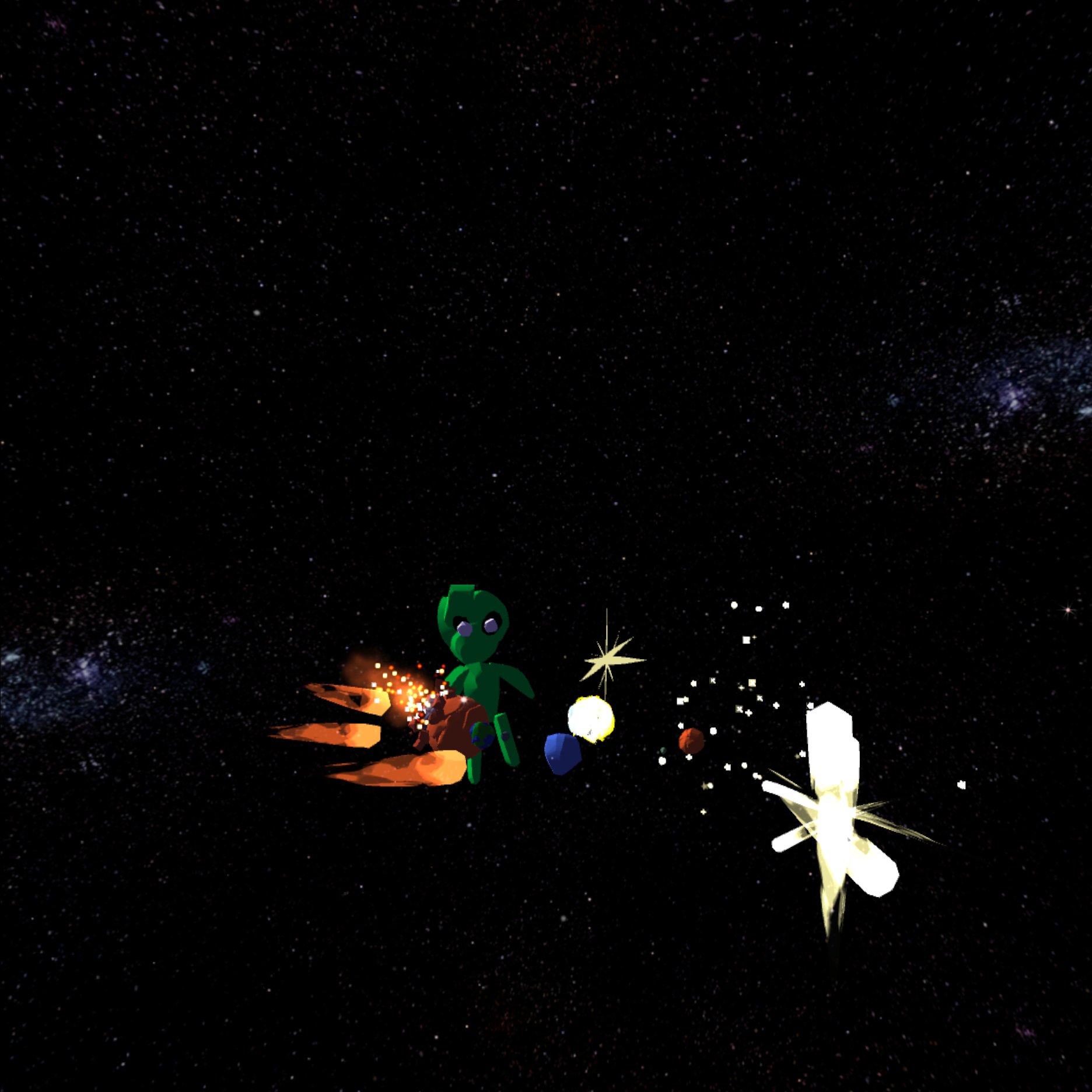
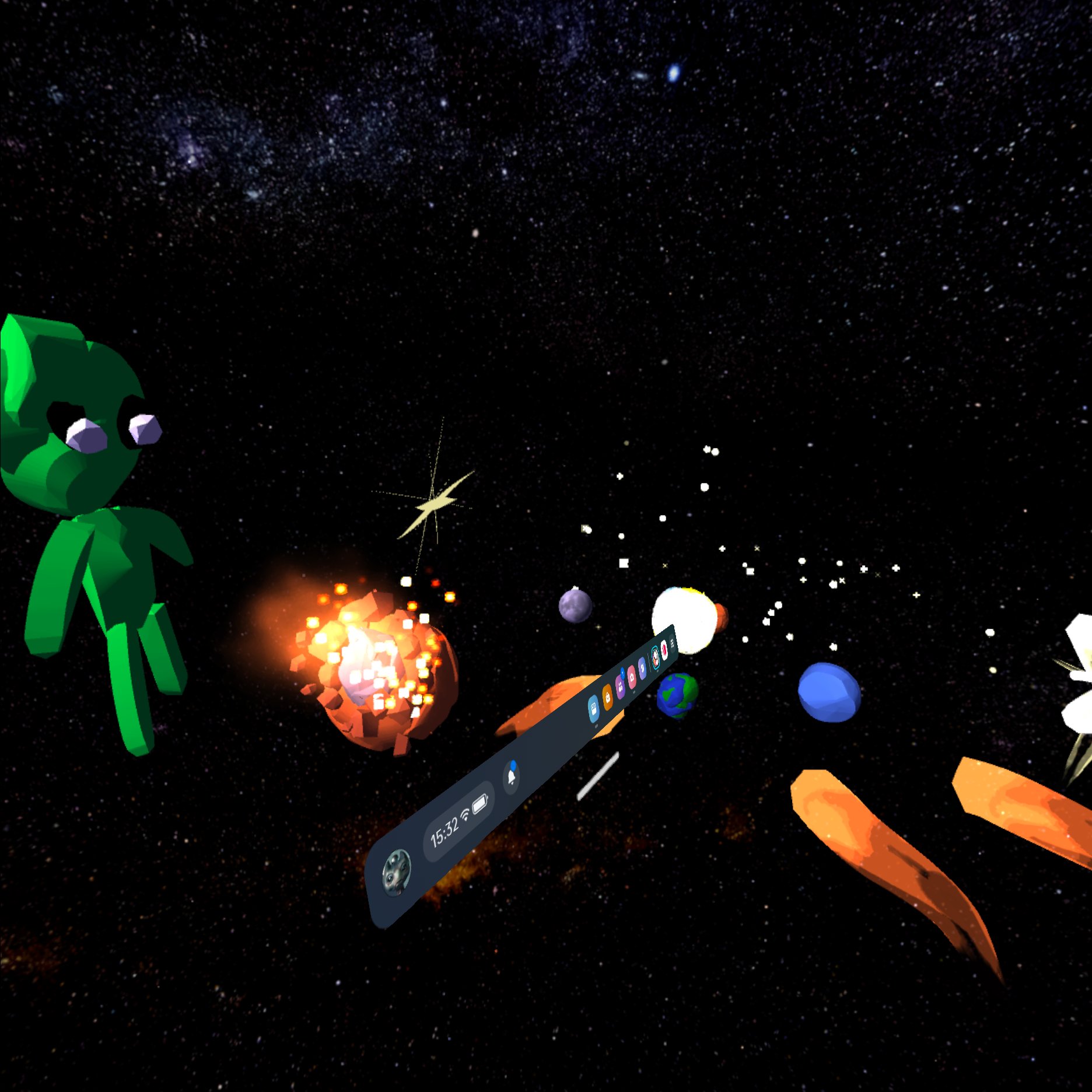
We then made another VR art piece but did a space scene and figured out some new tools such as the stars brush and the 3D brushes which made it easier and quicker to make spheres and other shapes. We again took it in turns but added our own ideas into the scene as we weren’t using any reference images, and we were just giving suggestions to each other and building on what we had all done. This was a better outcome because we had learnt more about how to use OpenBrush tools and the VR controls. If you had more time, you could make a larger scale artwork with more detail and use the tools to create different effects. 

Space diorama
Space diorama 2

“Using VR is an intense experience and using it for long periods of time could cause problems like eye strain. There is also a risk of injury while wearing a headset as your child cannot see their surroundings. If the game requires them to move around, they could trip or fall on other items in the room. Because of the way scenes move in VR, some people can feel motion sick when using it.” (NSPCC, ND)


In VR, you have to be mindful of new users because they may feel motion sickness due to the VR confusing their brains. To help fix this, you should start off with minimal movement so the user can get used to the sensation of VR. Another issue could be eye strain from extended use over time. It is important to offer notifications to users after a long period of use to encourage them to take breaks.

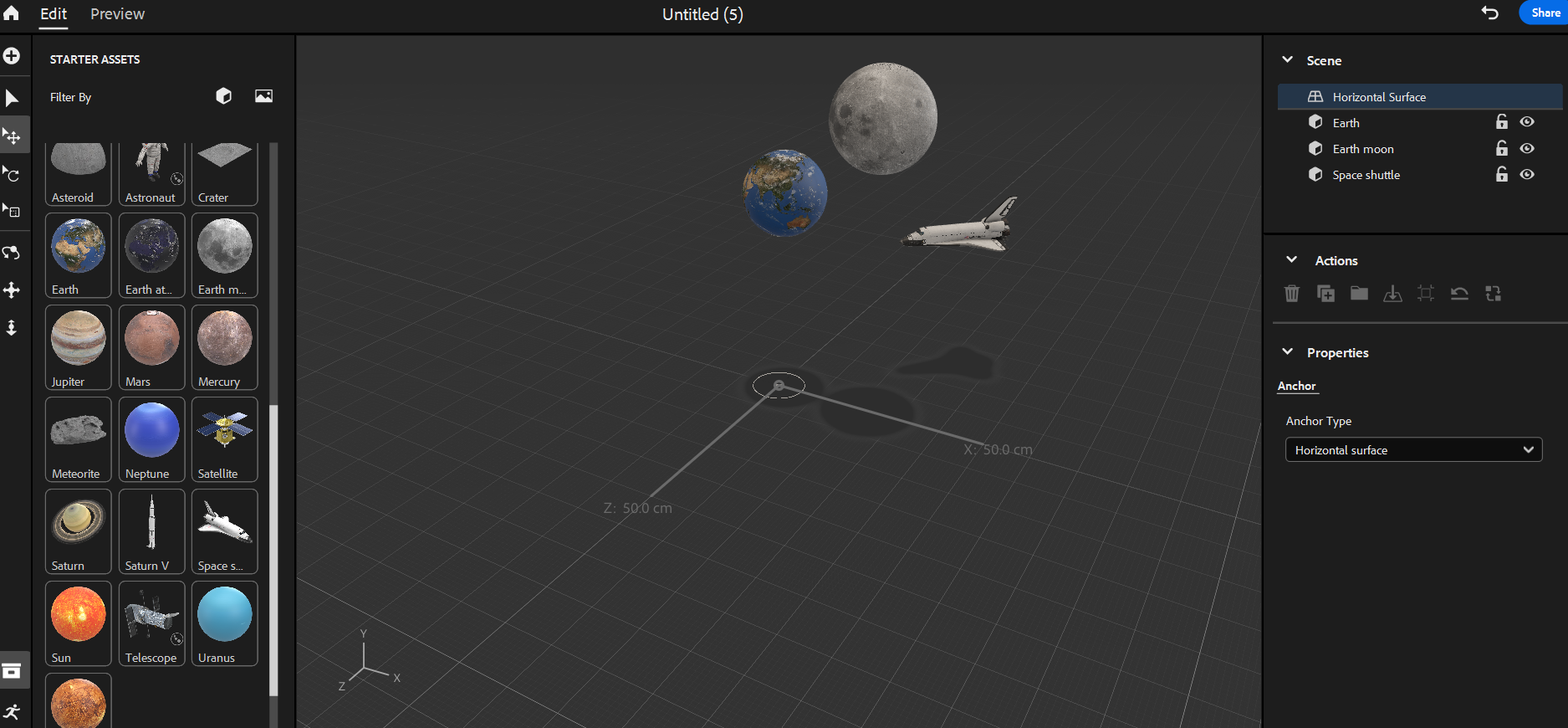
I then tried using Adobe Aero, which is an app for desktop and mobile which lets you create AR experiences. You can do marker-based tracking and even link it to Google Maps, where you can place objects into the real world, which can be viewed through scanning a QR Code and using a web app like Zapworks does. For my Adobe Aero experience, I arranged some planets and a space shuttle together before previewing it in the real world where the app detected planes within the room and projected the models into the real world. This is marker-less tracking and can be used to preview things in the real world to see how they would fit, such as furniture. 


“Marker-less AR offers the most control to the user as it allows the user to choose where they would like to place the content. It also allows real-life scale placement of the virtual augmented objects. These AR experiences are highly reliant on smart phone features such as sensors, camera, and processors.” (Digital Promise, nd)

Adobe Aero workspace

References

Digital Promise (nd) Types of AR – Digital Promise [Article]. Available online: Types of AR – Digital Promise [Accessed: 31/10/2024]


Laika LLC (2009) Coraline [Image]. Available online: https://encrypted-tbn3.gstatic.com/images?q=tbn:ANd9GcRDZZZjjXJsVyzSgxAT-QmgCeFVsB8fa6mI3iaBZuWYjoF8Ik3p [Accessed: 17/10/2024]


NSPCC (nd) Virtual Reality Headsets [Article]. Available online: Virtual Reality Headsets | NSPCC [Accessed: 31/10/2024]


TATE (2024) Modigliani VR The Ochre Atelier [Article]. Available online: https://www.tate.org.uk/whats-on/tate-modern/modigliani/modigliani-vr-ochre-atelier [Accessed: 31/10/2024]


TATE (2017) The Making of Modigliani VR: The Ochre Atelier [Video]. Available online: The Making of Modigliani VR: The Ochre Atelier – YouTube [Accessed: 31/10/2024]

Immersive User Experience (UX) and Augmented Reality (AR)

Immersive User Experience (UX) and Augmented Reality (AR)

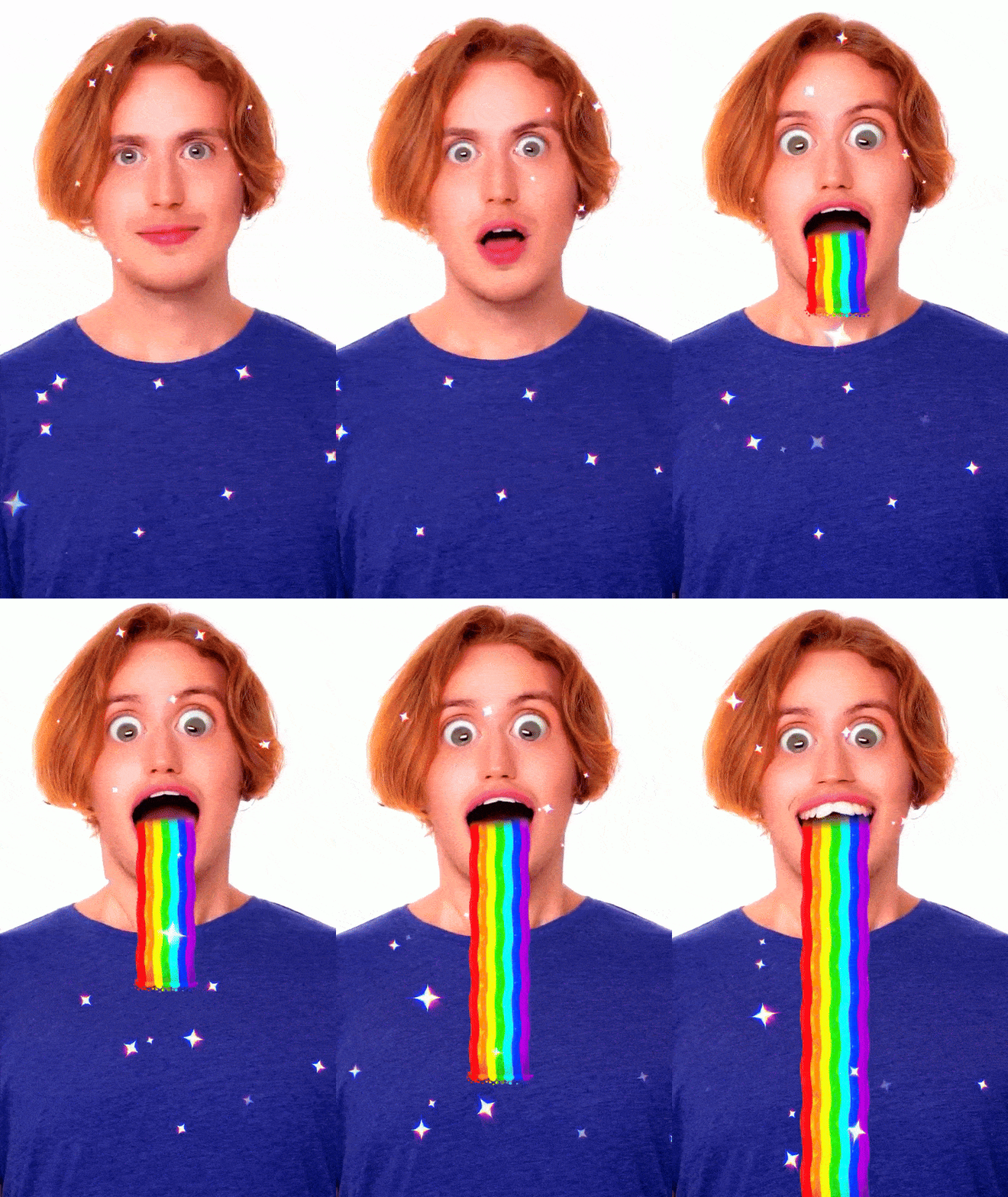
In week three of emerging technologies, we explored marker based AR techniques. Marker based AR uses patterns that cameras can process to trigger an interaction on screen (Digital promise, ND). Most marker based AR use mobile applications to access the devices camera and scan a trigger to make something happen on the users mobile device screen. An example of marker based AR is Snapchat filters. Snapchats camera detects the users face and overlays it with visual elements thar alter reality. A famous example is the puking rainbow filter which gave the users large eyes and made a rainbow fall out when they would open their mouth.

Snapchat rainbow vomit filter

When first introduced, Snapchat filters were a new fun and interactive experience for users, and allowed brands to collaborate with Snapchat in creative ways through custom filters.

‘AR Filters (post-capture) are designed to elevate brand engagement and interaction within the camera after content has been captured’ (Snapchat, 2024).

I have used Unity to create my own marker based AR interactions. I first followed a tutorial to become used to Unity and the Zapper camera. I learnt how to train images so that they could be used as targets to trigger the interaction to start. The first tutorial uses 2D elements over a tracker image, buy I then did the same but with a 3D object to create more dimension.

To preview the interaction, I had to upload my Unity files to Zapworks. Zapworks is a website which lets you produce no code augmented reality content and lets you share the content with other people without them needing to download any apps. Zapworks gave me a QR code which when scanned on a mobile device, opened a web browser page and allowed me to access the camera and motion sensors to then point at the trigger image, showing the animation. 

I then made my own AR interaction with a different image and a 3D model downloaded off the internet. When picking an image to use as a trigger there are some considerations you need to make. First, your image shouldn’t have too much blank space or solid colour because it is not recognised as complex data. Second, your image should have high contrast for better tracking performance. Third, you should avoid repetitive patterns, and finally, you should keep the image aspect ratio between 4:1 and 1:4 to avoid the file size being too big to load. (Zapworks, 2024)

My Zapworks interaction is a croissant on a plate in a cafe. When the image is aimed at, the croissant lifts from the plate to look like it is jumping out of the screen.

AR interactions can be used to promote. For example, an interactive poster for a film or event could have a QR code which tells users to point their phones at the poster for it to become three dimensional or animated. This makes the poster more dynamic and can create a viral marketing moment for the events.

References

Digital Promise (nd) Types of AR – Digital Promise [Article]. Available online:  Types of AR – Digital Promise [Accessed: 22/10/2024]


Snapchat (2024) About AR Filters [Article]. Available online: About AR Filters [Accessed: 22/10/2024]


Snapchat (2024) Puking Rainbow Lena by Snapchat [GIF]. Available online: Puking Rainbow Lens by Snapchat – Snapchat Lenses and Filters [Accessed: 31/10/2024]


Unknown (nd) Plates on Table [Image]. Available online: https://www.google.co.uk/url?sa=i&url=https%3A%2F%2Fwww.pinterest.com%2Fpin%2F179088522672465545%2F&psig=AOvVaw03vlZLM6alGKjimxdQWCFK&ust=1730723153127000&source=images&cd=vfe&opi=89978449&ved=0CBQQjRxqFwoTCKDz8qeUwIkDFQAAAAAdAAAAABAE [Accessed: 10/10/2024]


Zaal, Greg (2022) Croissant Model [3D Model]. Available online: Croissant Model • Poly Haven [Accessed: 10/10/2024]


Zapworks (2024) What Makes a Good Tracking Image? [Article]. Available online: General | What Makes a Good Tracking Image? [Accessed: 22/10/2024]

Prototyping Your Immersive Experience

Prototyping Your Immersive Experience

In week one of Emerging Technologies, we learned how to create 360 videos in Blender and to publish them onto YouTube as VR format. 

360 videos create more immersive content because they allow the viewer to explore the whole scene by dragging their mouse around the screen to the places they want to look at. It is like a panoramic picture, which shows an orthographic view of a scene and multiple angles at once, but with a 360 video there is more control since the camera can be moved around instead of everything being presented in one flat view. 

“It gives the user a sense of being inside the video, experiencing it from within, making it somewhat immersive.” (VRdirect, 2023) 

The viewer feels like they are inside of the video, and they are given more control because they can look around and see everything all around them instead of being limited to only one place to look. 

To make my own 360 video, I started in Blender by adjusting the camera settings to capture a panoramic view of the workspace. This makes the scene look like a 2D panoramic image when rendered out, but I then imported the image sequence into Premiere Pro to make it into a clip before uploading it to YouTube as a VR video. 

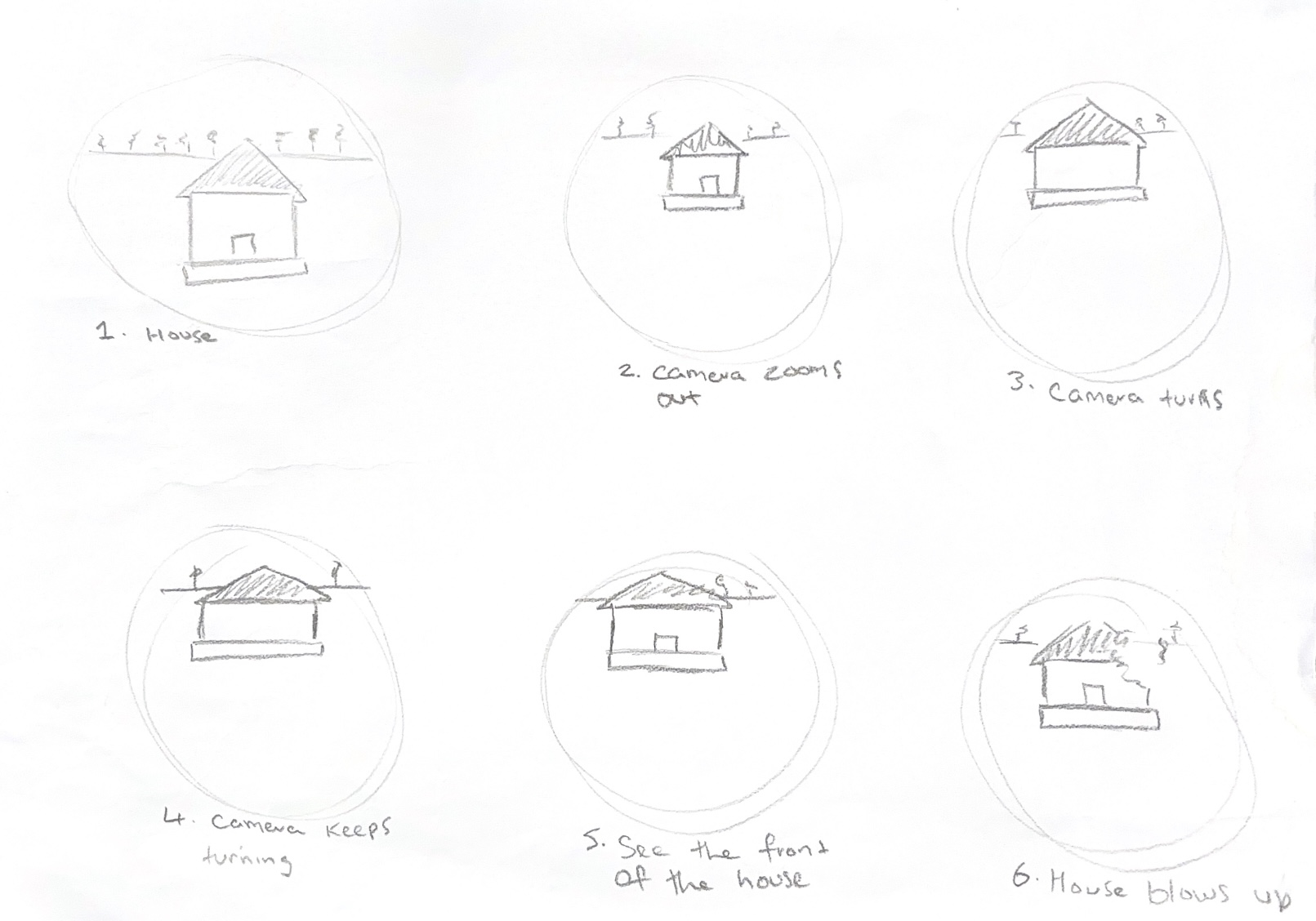
For my 360 video, I first made a story board to plan what would happen and I decided to make a simple animation showing a house in a forest. The camera moves around a little bit to show different parts of the scene but I didn’t add too many details as this was a simple animation to test the use of 360 VR camera. 

360 storyboard

In Blender I imported a HDRI and a model of a house which I made. I had already set the camera up, so I just added some movements around the house with the camera. I tried to keep the camera movements minimal because lots of users can experience motion sickness in VR because it can confuse the senses. I set the scene to 300 frames at 30fps, creating a 10 second animation. It took a while to render because it was in cycles, so if I were to make another, I would consider this in advance, so I had enough time to produce my animation because you can only set up a 360 camera in cycles and not EEVEE.  

360 VR videos are a good way to make the user feel like they are in the video. They can also be used to enhance the real world around them, like at Alton Towers where the ride ‘Galactica’ used to be a VR ride which let users wear headsets whilst on the ride, making them feel like they are flying through space. This matched the cosmic theming of the roller coaster and created a more memorable and immersive experience for riders. This video shows a side-by-side comparison of the ride with VR and without, and you can see that the VR offers more storytelling through visuals and sounds combined with the motion from the coaster. 

In week one, we also learnt how to use geometry nodes in Blender to make something break apart. I practiced doing this on a cube. These effects could be used in a 360 animation to make the story more exciting and add interesting movements.

In week two, we tried out FrameVR. FrameVR is a website that allows you to interact with other users by joining them in different worlds. The FrameVR website says that it can be used for remote work, virtual meetings and sales and marketing.  

“Frame makes it easy to communicate and collaborate in 3D environments, right from the web browser” (FrameVR, 2024)  

In FrameVR you can upload your own objects for others to look at, or they can even collaborate and add their own. Supported objects include images, videos, 3D models, audio files and documents. Users can also chat through their microphone or by text chat boxes which display chat bubbles over their avatars. 

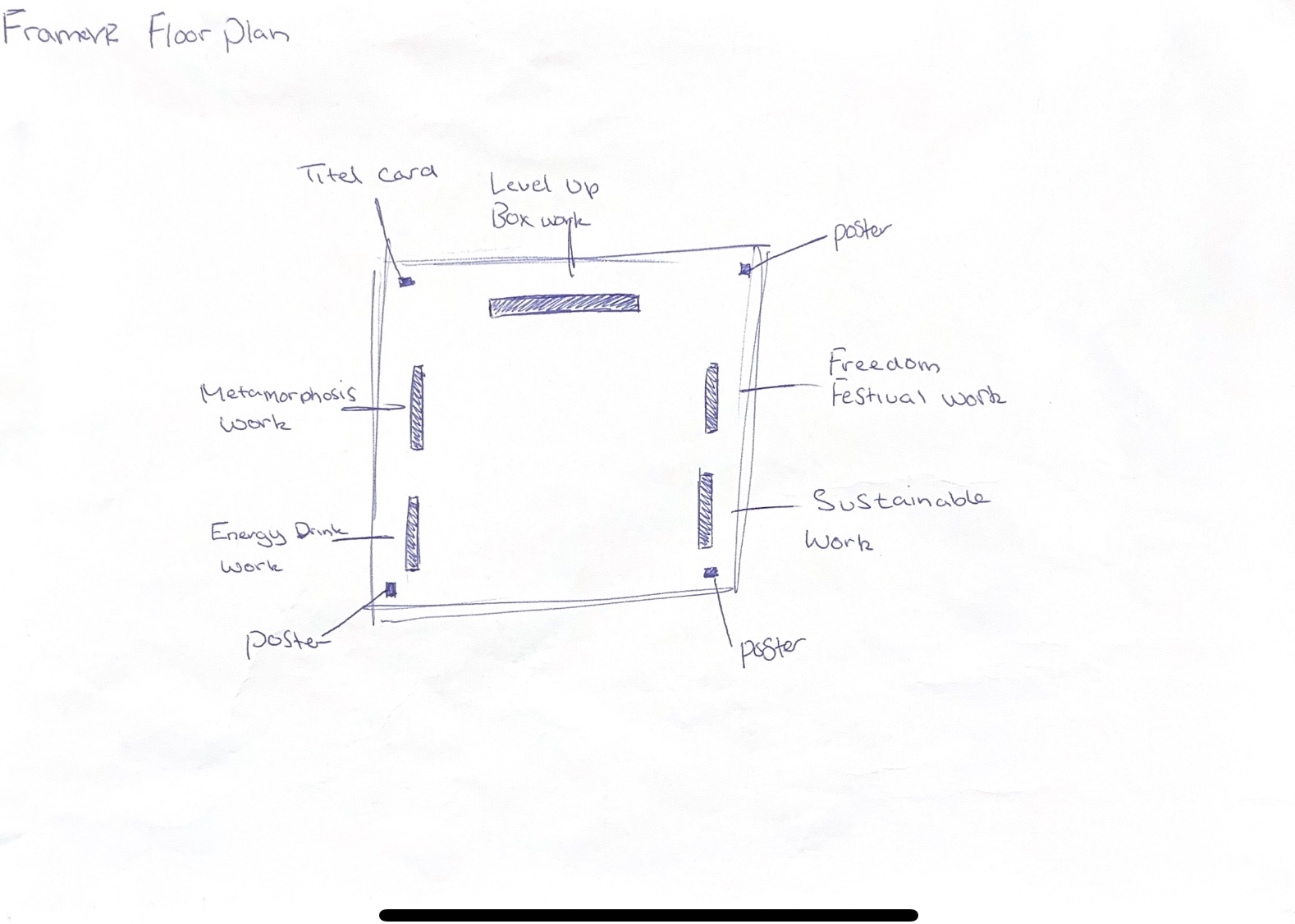
In FrameVR, you can make your own world and invite others to join you. When I started making my own world, I thought of what I might want to showcase to users. I decided to show off my work from my first and second year at university and some work from outside of university. I made a sketch to plan the world out and decide how to lay my work out to users visiting the world. 

Floor Plan for my FrameVR room.

I then imported my work into FrameVR where I wanted each piece to be and invited classmates to join and look around at my work. It felt like a museum exhibition, which is one way a platform such as FrameVR could be used to present work to other people. 

Another similar platform to FrameVR is RecRoom, which is a cross-platform game available on PC, Console, mobile and VR. Users can create their own custom avatar to represent themselves and join different rooms to chat and interact with others. 

Picture of Rec Room logo of Internet

 Both RecRoom and FrameVR allow users to join in VR experiences and use their own avatars, but there are some considerations for these types of platforms. One of the biggest issues is online harassment and safety, especially for young users.  

“Researchers found that social VR users face unique safety challenges shaped by new social norms and cultural values.” (Zheng, 2023) 

Social VR safety is a growing issue since users can connect with all sorts of people, which presents them with risks such as verbal harassment, virtual violence, cyberbullying and more It is important to consider user safety and put clear policies in place for misconduct and offer support to users who might feel harassed. 

References

FrameVR (2024) Frame – Immersive Meetings, Classes, Events [Webpage]. Available online: https://learn.framevr.io/ [Accessed: 16/10/2024]


Rec Room (2024) Rec Room  [Image]. Available online: https://www.google.co.uk/url?sa=i&url=https%3A%2F%2Frec.net%2Fswitch&psig=AOvVaw3tet1qTj5qIlxcpu-NnqXO&ust=1730721885164000&source=images&cd=vfe&opi=89978449&ved=0CBQQjRxqFwoTCIj_iMuPwIkDFQAAAAAdAAAAABAE [Accessed: 31/10/2024]


SmoothCoasters (2022) Galactica, Alton Towers, VR vs No VR Side By Side comparison POV [Video]. Available online: https://www.youtube.com/watch?v=mVXnpSaU1Hs [Accessed: 31/10/2024]


VRDirect (2023) What are 360° videos, and how can you use them in a VR project to make things immersive? [Quote]. Available online: What are 360° videos, and how can you use them in a VR project to make things immersive? – VRdirect [Accessed: 25/10/2024]


Zaal, Greg (2017) Autumn Hockey HDRI [HDRI]. Available online: https://polyhaven.com/a/autumn_hockey [Accessed: 12/10/2024]


Zheng, QingXiao (2023) Social VR Safety: New Research Insights into Risks and Protections in New Online Spaces [Article]. Available online: https://medium.com/acm-cscw/social-vr-safety-new-research-insights-into-risks-and-protections-in-new-online-spaces-fa9c88e6f273#:~:text=Safety%20concerns%20aren%E2%80%99t%20solely%20due%20to%20design%20flaws,from%20offline%20norms%2C%20further%20complicate%20safety%20risk%20management [Accessed: 25/10/2024]

Research for Major Project

Research for Major Project

My major project idea is to create a range of healthy alternatives for fast food options aimed at children. Many children’s diets are made up of sugary, fatty and processed foods which are addictive. I want to create a healthier option for children and parents, which tastes like their favourite foods but is better for their health. 

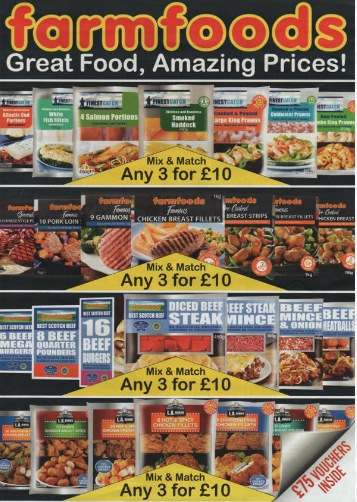
One reason why parents choose to buy unhealthy foods is because they may have a lower income and cannot afford to buy whole foods and ingredients. Shops like Iceland and Farmfoods stock lower quality food items at cheaper prices, so they are more available to struggling families on a budget. These shops also sell lots of frozen ready meals, which can be quickly cooked in the oven or microwave and don’t take a lot of time or effort, which could be useful to parents who are in a hurry and do not have time to go to the shops looking for ingredients and then coming home to cook it, and do the dishes afterwards. 

Farmfoods sell cheap ready meals which are easy to cook

Ready meals are convenient for parents in a rush, but they are high in salts and fats, whilst lacking nutritional value which is important for children’s health and development. They also have added ingredients to preserve them and make them more addictive. You can usually make the same meals with less ingredients and more healthy value to them, but they take more time and preparation and could be more expensive than just buying the ready meal itself. 

58% of UK households choose to order a takeaway instead of cooking a meal, spending an average of £54.60 per month (FurnitureChoice, ND). Chinese, Indian and Italian are some of the most popular forms of takeaway foods, so I am going to focus on creating products inspired by these foods and chains such as McDonald’s and KFC.

Most families choose to order takeaways because it requires less cooking and cleaning, and they don’t have to worry about going and buying ingredients to make these foods. Having the time to go and buy ingredients, come home, cook the food and then clean up after can be rare for some parents who might have busy schedules and long work hours. The big issue with takeaway food is the high sodium, fat and sugar content, all of which are bad for your health and can affect things such as blood pressure and weight. They lack vitamins and minerals too which can lower your mood. Studies have shown that unhealthy food can contribute to depression by affecting the gut bacteria which then affects the production of serotonin, causing low mood. (Health 360, 2024) 

Lots of food products marketed towards children can be high in sugar, which leads to obesity, tooth decay and other health problems. Research conducted on rats proved that sugar is more addictive than opioid drugs (Ramsay Health Care, ND). Giving children lots of sugar at a young age can cause them to become addicted to it, leading to a lot of issues to their health in the future. 

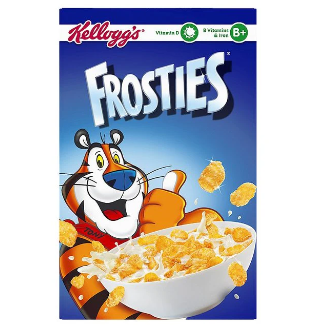
Unhealthy food packaging is purposely designed to appeal to children by looking fun and exciting. A lot of foods use bright colours and cartoon mascots, like Kellogg’s Frosties and Coco Pops, which are cereals aimed to children. A recommended 30g serving of Frosties is 13g of sugar, meaning almost half of the serving is purely sugar, which will cause a spike in blood sugar early in the morning for kids. The recommended serving of free sugar is 24g (NHS, 2024) for children and a bowl of cereal means they have already had half of their daily allowance as soon as they wake up. 

Frosties appeal to children with their Tiger mascot

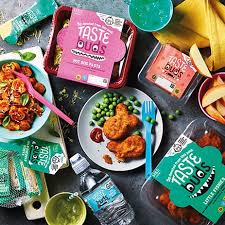
There are some healthy foods that are made specifically for children, such as M&S Taste Buds. They are ready meals which can be cooked quickly for children but contain healthier food sources and are more nutritious. They use mascot characters and bright colours similar to Kellogg’s but are using it to promote a healthier option. They also have slogans on the packaging which mentions them being high in protein and one of your five a day, which encourages parents to buy these instead of other options. This is something which I also would like to do when I create my own products as it will look just as appealing but will be a better alternative parents can buy for their children. 

M&S Taste Buds are healthy meals for children

References

Farmfoods (nd) Farmfoods Advertisement [Image]. Available online: https://www.google.co.uk/url?sa=i&url=https%3A%2F%2Fstopjunkmail.org.uk%2Fblogs%2Froyal-junk-mail%2Fjunk-mailer%2Ffarmfoods.html&psig=AOvVaw0YPOigevbPKEiw4j1V-cei&ust=1730719122640000&source=images&cd=vfe&opi=89978449&ved=0CBQQjRxqFwoTCJDyj6eFwIkDFQAAAAAdAAAAABAv [Accessed: 29/10/2024]


FurnitureChoice (2018) Takeaway Cities: Taking a look at the UK’s takeaway habits [Article]. Available online: https://www.furniturechoice.co.uk/inspiration/takeaway-cities-taking-a-look-at-the-uks-takeaway-habits_a10000131 [Accessed: 18/10/2024]


Health360 (2024) Link between fast food and depression [Article]. Available online: https://intermountainhealthcare.org/blogs/fast-food-depression-link [Accessed: 18/10/2024]


Kellogg’s (2024) Kellogg’s Frosties Cereal [Image]. Available online: https://www.google.co.uk/url?sa=i&url=https%3A%2F%2Fsachetsandmore.com%2Fproducts%2Fkelloggs-frosties-mini-cereal-portion-35g&psig=AOvVaw2obOPkFgZuMbhPn9PenZ8D&ust=1730720120481000&source=images&cd=vfe&opi=89978449&ved=0CBQQjRxqFwoTCKDEs4GJwIkDFQAAAAAdAAAAABAn [Accessed: 29/10/2024


M&S (nd) M&S Taste Buds [Image]. Available online: https://www.google.co.uk/url?sa=i&url=https%3A%2F%2Fwww.marksandspencer.com%2Fc%2Ffood-to-order%2Ftaste-buds&psig=AOvVaw2f5PNSDObPGgTJ8q2zUO5G&ust=1730719945105000&source=images&cd=vfe&opi=89978449&ved=0CBQQjRxqFwoTCLis5K2IwIkDFQAAAAAdAAAAABAE [Accessed: 29/10/2024]


NHS (2024) Sugar: The Facts [Article]. Available online: https://www.nhs.uk/live-well/eat-well/food-types/how-does-sugar-in-our-diet-affect-our-health/ [Accessed: 18/10/2024]


Ramsay Health Care (nd) Is Sugar More Addictive Than Cocaine? [Article]. Available online: https://www.ramsayhealth.co.uk/blog/lifestyle/is-sugar-more-addictive-than-cocaine [Accessed: 18/10/2024]